If your WhatsApp account has been blocked, the first thing to establish is which account. The WhatsApp Business app and the WhatsApp Business Platform are two different products with two different enforcement systems, and the way back is different for each. The trigger, though, is nearly always the same: messages went to people who had not asked for them, and enough of those people blocked or reported you.
One distinction first, because WhatsApp uses three different words for three different states. This page deals only with a full ban. If WhatsApp is showing you “Your account is restricted”, you are in the wrong place — that is a time-limited block, covered in what to do when your WhatsApp account is restricted. If it says “Your account is under review”, likewise — that is the state before any decision, covered in WhatsApp account under review.
In short
- Quality rating drives the whole mechanism. Meta's documentation states that a number flagged for 7 days has its messaging limit lowered by one level immediately (Meta for Developers, retrieved August 2026).
- A new Business Platform number starts at 250 unique recipients per moving 24 hours outside an open service window, and scales up from there — it does not start unlimited (Meta for Developers, retrieved August 2026).
- Documented opt-in is the only prevention that holds. Stores that ask for the phone number at checkout move from roughly 22% to 65–70% phone coverage, and a list built that way does not report you.
Which WhatsApp account actually got banned?
Start here: the two cases share almost nothing beyond the word "blocked".
The WhatsApp Business app is the free app you install on a phone. It runs under consumer terms, and bulk or automated sending from it is the single most common reason a number disappears. There is no quality dashboard, no messaging-limit display and no published appeal timeline. If this is your situation, your leverage is limited and your first move is to stop sending, not to write a better message.
The WhatsApp Business Platform is the API path. Accounts here are rarely "banned" outright — they get restricted, in graded steps: your quality rating drops, your messaging limit falls, templates get rejected or recategorised, and only after repeated violations does the account itself get restricted. Each of those steps is visible to you before the next one lands, which is the practical argument for the Platform. The difference between the two products, and which one a store needs, is covered in our comparison of WhatsApp and WhatsApp Business.
Keaz runs on the Business Platform, so every number connected through it sits in the graded system rather than the all-or-nothing one — see what the platform does.
Why does WhatsApp restrict business numbers?
Volume is not what gets you restricted. The block and report rate of the people you send to is. Six causes account for most cases:
- No documented opt-in. Meta's own policy requires opt-in before you message someone, and requires that the opt-in names the business collecting it (Meta for Developers, retrieved August 2026).
- Bought, scraped or imported number lists. No consent behind them, and they report at a rate no message quality can offset.
- Bulk sending from the Business app. Broadcast lists and automation tools bolted onto the consumer app are the classic path to a lost number.
- Irrelevant or too-frequent marketing. A weekly discount blast to the whole customer base earns blocks even from people who genuinely opted in.
- Ignoring blocks and unsubscribes. If someone opts out and keeps receiving campaigns, the next step is a report.
- Template misuse. Putting promotional content in a utility template does not hide it. Meta re-checks template categories on a recurring basis and moves a mislabelled utility template to marketing with one day's notice (Meta for Developers, retrieved August 2026).
The rule of thumb: you are not judged on how many messages you send, but on how recipients react to them. Ten thousand messages to a consented, well-segmented list is safer than two hundred to a bought one.
The full rules are published as the WhatsApp Business Messaging Policy (Meta, retrieved August 2026) — short enough to read once properly.
What happens when your quality rating drops?
The mechanism is documented, and worth knowing before you need it.
Each of your numbers carries a quality rating derived from recent recipient feedback — blocks and reports. Meta's enforcement documentation states that a number flagged for 7 days has its messaging limit lowered by one level immediately, and that repeated violations lead to restrictions that increase in duration (Meta for Developers, retrieved August 2026).
The messaging limit is the ceiling that then bites. Meta defines it as the maximum number of unique WhatsApp users you can message outside of an open customer service window within a moving 24-hour period, and it accrues at the level of your whole business portfolio rather than per number — so a second number does not buy you headroom. New numbers begin at 250 and scale toward 2,000 through the documented scaling paths, after which scaling continues automatically when quality stays high and you actually use the limit you have.
One related mechanic matters here: a 24-hour customer service window opens when a customer messages you and resets each time they message again. Outside it, only approved templates go out at all.
So a quality drop is not an abstract score. It cuts the audience you can reach tomorrow, which for most stores is measurable in revenue — our Forecast puts a number on what your reachable customer base is worth per month.
What should you do if your account is already banned?
There is no trick, and anyone promising a fast unblock is selling something. This is the sequence that applies.
- Establish which product you are dealing with — app or Platform. Everything after this differs.
- Stop all outbound sending immediately. Not reduced: stopped. Continuing to send into a flagged number deepens the problem while you work on it.
- File an appeal. For Business Platform accounts, Meta routes appeals against an account ban through Business Support Home; the enforcement documentation is the reference for what can be appealed and what cannot (Meta for Developers, retrieved August 2026).
- Fix the list, not the copy. Remove contacts you cannot prove consent for, and remove the ones your messages never reached. In Keaz the Segment Builder has conditions for exactly this — “Message could not be delivered” and “Opt-in level” — so the cleanup is a segment rather than a spreadsheet.
- Re-permission rather than re-blast. For customers who have been dormant longer than twelve months, Smart Activation asks for consent again, and it is deliberately capped at twice a year. Asking is slower than sending. It is also the only version that survives.
- Resume slowly, useful content first. Order updates and genuinely transactional messages rebuild a quality rating; a discount campaign does not.
Meta publishes no timeline for appeals against a ban, so nobody can honestly give you one. Assume the number is unavailable for a while and that the list rebuild is the real work.
How do you send at volume without triggering this?
Prevention is structural. Three things do the heavy lifting.
Make consent a field, not an assumption. Keaz records how much consent each contact has given as an opt-in level, and you set a minimum level as a filter on a flow, so only sufficiently opted-in contacts enter it — see opt-in levels: how subscribing and unsubscribing works. The rule from that page is worth repeating: set the opt-in filter on every marketing flow, not just the obvious ones. Collecting that consent in the first place is covered in our guide to GDPR-compliant WhatsApp opt-in.
Send to segments, never to everyone. A newsletter in Keaz always goes to a segment rather than hand-picked contacts, and the send panel shows the segment size before you commit. It also carries an explicit recommendation: "Try to secure the quality of your WhatsApp account by sending newsletters at a moderate frequency and specifically to the interests of your segments." Frequency and relevance are what keep block rates low.
Treat WhatsApp as an addition to email, not a replacement. Published benchmark bands put WhatsApp read rates above 90% against email open rates of 30–40%, with about 1.5× the conversion rate on a shared audience — labelled bands rather than promises, and how we calculate them is written up separately. Those read rates cut both ways: an irrelevant message on WhatsApp gets noticed in a way the same message in an inbox does not.
Building the sending side from scratch? How to set up a WhatsApp newsletter walks through templates, segments and cadence together.
Common mistakes
These are the ones that cost stores a number, in rough order of frequency.
- Importing a customer list and sending to it on day one. Having someone's phone number from an order is not consent to market to them. Ask first.
- Running campaigns from the Business app because the Platform looks like more work. The app has no quality signal to warn you, so the first feedback you get is the ban.
- Treating an unsubscribe as a data field instead of a stop signal. If your opt-out does not actually remove someone from the next send, you have built a reporting machine.
- Sending a re-permission campaign to everyone at once after a restriction. This is the exact behaviour that caused the restriction, repeated at a worse moment.
- Relabelling a marketing template as utility to reach people outside the service window. Categories get re-checked, and the correction lands with one day's notice.
- Adding a second number to escape a low limit. Messaging limits accrue across your whole business portfolio, so the new number inherits the problem.
Almost every WhatsApp ban traces back to the same root cause, and it is not a technical one: someone was messaged who had not agreed to it. So the fix is not a better template or a different provider — it is a list you can prove consent for, segments narrow enough to stay relevant, and a cadence that does not exhaust the people on it. Get those three right and the quality rating looks after itself.
Worth knowing before you build the sending side: how much of your customer base is reachable on WhatsApp, and what that is worth per month. Calculate your forecast — a few minutes, no code.
This article is a summary rather than legal advice. Consent requirements differ by market and by how you collect them, so have your own counsel review your opt-in flow before you rely on it.
Sources: Meta for Developers — policy enforcement documentation and the WhatsApp Business Messaging Policy, both retrieved August 2026. Product behaviour is from the Keaz help center, retrieved August 2026.
Frequently asked questions
Can a blocked WhatsApp number be recovered?
How long before a WhatsApp ban is lifted?
Does sending fewer messages fix a low quality rating?
Will using an official provider prevent a ban?
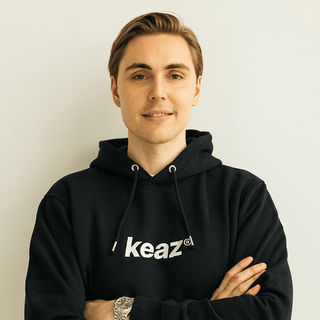
Nils Spölgen
Founder at Keaz. Serial founder in chat marketing — built a local agency into Keaz, the WhatsApp marketing platform for Shopify. Bootstrapped the MVP, raised funding, and scaled to 200+ merchants in DACH. Writes about flows, opt-in & GDPR, Klaviyo, and realistic revenue benchmarks — prefers conservative math over impressive claims. View profile