WhatsApp marketing is GDPR-compliant — but only with an explicit, documented and revocable opt-in. A phone number someone typed into your Shopify checkout is not consent to market to them. The useful part: asking properly is also the fastest way to build reach, because roughly a third of your customers can be reached on WhatsApp and nowhere else.
- 34% of customers are reachable on WhatsApp only — against 24% email only, 38% on both, 3% on neither
- Most Shopify shops start able to reach 35–55% of their last-12-months customers; past 85% within about 60 days is normal
- Biggest single lever: the phone field at checkout — capture reaches 65–70% once it is set to encouraged
What makes a WhatsApp opt-in GDPR-compliant?
Three things have to be true at the same time. Miss one and the list is unusable — not only legally, but practically, because people who never asked to hear from you block and report, and that costs you the channel.
Explicit. The customer actively agrees to receive WhatsApp messages from you for marketing, and that agreement is separate from placing an order. A single checkbox bundling "I accept the terms and want WhatsApp offers" is not explicit consent.
Documented. For each contact you can show when they agreed, where they agreed and what wording they saw. If you cannot produce that record, you do not have consent — you have a phone number.
Revocable. Opting out is as easy as opting in, and it takes effect immediately. Every marketing message carries an obvious way out.
The rule of thumb: if you cannot name the moment a contact said yes, do not message them. Ask first.
These three are not a Keaz house rule. They restate the GDPR's own definition of consent — freely given, specific, informed and unambiguous, given by a clear affirmative act — together with the conditions for demonstrating it and for withdrawing it, set out in Articles 4(11) and 7 of Regulation (EU) 2016/679 (GDPR) (EUR-Lex, retrieved 8 October 2026). The European Data Protection Board works through what that means in practice — including why consent bundled into other terms does not qualify — in its Guidelines 05/2020 on consent (EDPB, 2020, retrieved 8 October 2026).
Where do WhatsApp opt-ins actually come from?
Opt-ins come from moments where the customer already has a reason to hand over their number. These are the places worth using, roughly in order of yield:
- Phone field at checkout — the largest single source, because it sits in the most engaged moment of the whole journey. Set it to encouraged rather than required.
- Post-purchase opt-in — catches customers whose number was not in the checkout, while intent is still high.
- Order-confirmation opt-in — the one message every customer opens.
- Subscriber pop-up on your storefront — usually paired with a first-order incentive.
- Page widget — a chat button for customers who would rather start the conversation themselves.
- QR codes — packaging inserts, retail, events. Slow but free.
- Link in bio and referrals — small volumes, high intent.
- Click-to-WhatsApp ads — Meta ads that open a chat instead of a landing page, at 3–4× the conversion rate of a standard ad.
If you already run an email tool, two more open up: a permanent WhatsApp opt-in link in the footer of every email you send, and a one-off invitation to your existing list. Both convert email reach into WhatsApp reach without buying a single click.
What about the customers who were never asked?
Every Shopify store has a back catalogue: customers who bought once, twice or a dozen times, years ago, and were never asked about WhatsApp. You cannot simply start messaging them. You can ask them once.
That is what Smart Activation does: a single re-permission message to customers who ordered more than 12 months ago, asking them to opt in. It is deliberately throttled to two runs per year.
Two things are worth understanding about it. Asking is not marketing — the message requests consent, it does not sell, and that distinction is the entire point. And the throttle is protective rather than technical: repeatedly working a dormant list is how stores get reported.
For shops with an email tool connected, this is where the numbers move most. The share of an existing email list that can also be reached on WhatsApp typically starts at 15–30% and gets to 50–70%. One re-permission run often unlocks more reachable contacts than the next 90 days of new orders combined.
How to set this up in your shop
Six steps, in this order. The first two do most of the work.
- Turn on the phone field in your Shopify checkout and set it to encouraged. One setting, largest effect. For buyers who leave it blank, the thank-you page widget catches the number after the order instead of losing it.
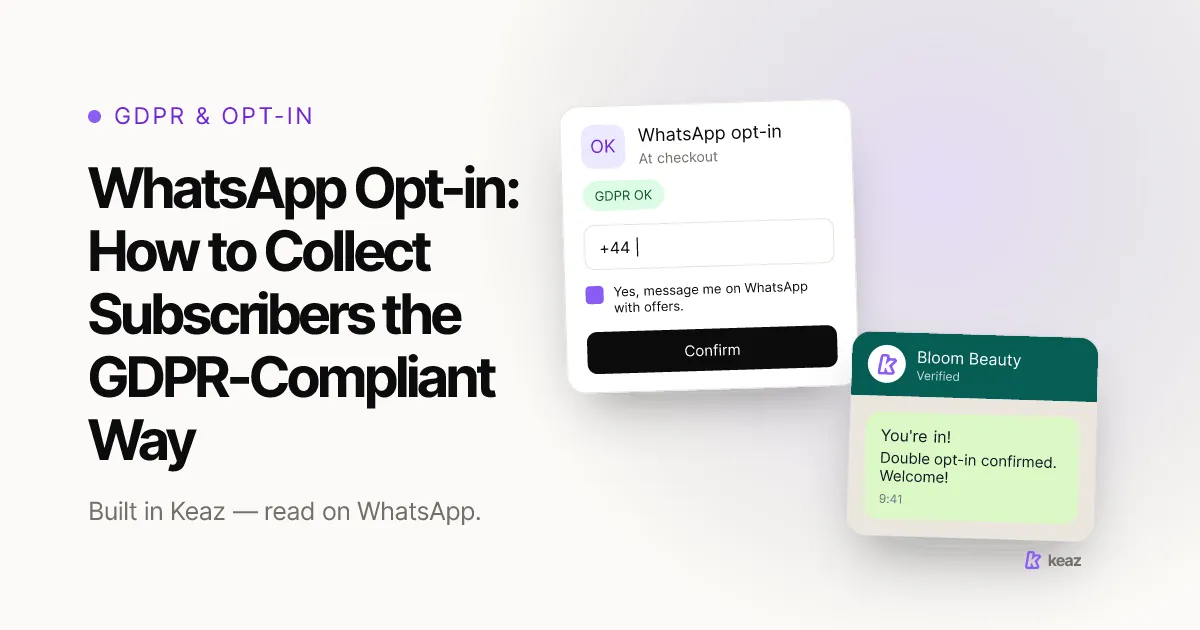
- Put a welcome message live. It confirms the opt-in on WhatsApp itself — which is your consent record — and it starts a relationship instead of leaving a number sitting cold. Keaz stores the result as the contact's opt-in level, which every marketing flow can filter on.
- Add one active capture point: the pop-up or the post-purchase opt-in. One, not all of them — otherwise you cannot tell what worked.
- Switch on the passive ones: page widget, QR codes on packaging, link in bio, email footer. They cost nothing per month and they compound.
- Run Smart Activation on the back catalogue. Once, then measure — you only get two runs a year.
- Watch one number: the share of your last-12-months customers you can reach on WhatsApp. If it is not moving, the capture point you added is not working.
None of this replaces your email programme. WhatsApp reaches the customers email loses and lifts conversion on the ones it already reaches — from 2.1% to 4.5% on a shared audience, or roughly 1.5×. We cover that split in our comparison of WhatsApp and email marketing, and the wider setup in the complete WhatsApp marketing guide for Shopify.
Common mistakes
Four failure modes account for most of the trouble shops get into here. Each is cheap to avoid and expensive to undo.
Treating a delivery number as consent. A number typed into checkout so a parcel arrives says nothing about wanting offers. Messaging that list produces blocks and reports, and enough of those put the sending account itself at risk — you lose the channel to save a week of asking.
Bundling consent into the terms checkbox. One box covering "I accept the terms and want WhatsApp offers" is not separate, and therefore not explicit. It also destroys the record: you cannot later show what the customer was actually agreeing to.
Working the back catalogue too often. Smart Activation is capped at two runs a year on purpose. Asking dormant customers again and again is the pattern that gets stores reported — the cap is the protection, not an obstacle to route around.
Skipping the welcome message. It looks optional, and it is the one step that produces a consent artefact the customer created themselves. Without it you have collected a number and documented nothing — which is the position you were trying to get out of.
Opt-in is not the compliance tax you pay before WhatsApp starts working. It is the thing that makes WhatsApp work. A list of people who said yes reads, replies and buys. A list of numbers nobody asked about gets you reported.
Two moves cover most of the distance: turn on the phone field at checkout, and ask your back catalogue once.
What is that reach worth in your shop? Run the forecast — enter your vertical, revenue and customer count, and see what each unused flow costs you per month. How we calculate it is documented in the forecast methodology.
This is a summary rather than legal advice. Have your own counsel review how it applies to your shop.
Frequently asked questions
Is WhatsApp marketing allowed in Germany?
Can I message the phone numbers I already have from Shopify orders?
Do I need a double opt-in for WhatsApp?
How quickly does a WhatsApp list actually build?
Nils Spölgen
Founder at Keaz. Serial founder in chat marketing — built a local agency into Keaz, the WhatsApp marketing platform for Shopify. Bootstrapped the MVP, raised funding, and scaled to 200+ merchants in DACH. Writes about flows, opt-in & GDPR, Klaviyo, and realistic revenue benchmarks — prefers conservative math over impressive claims. View profile