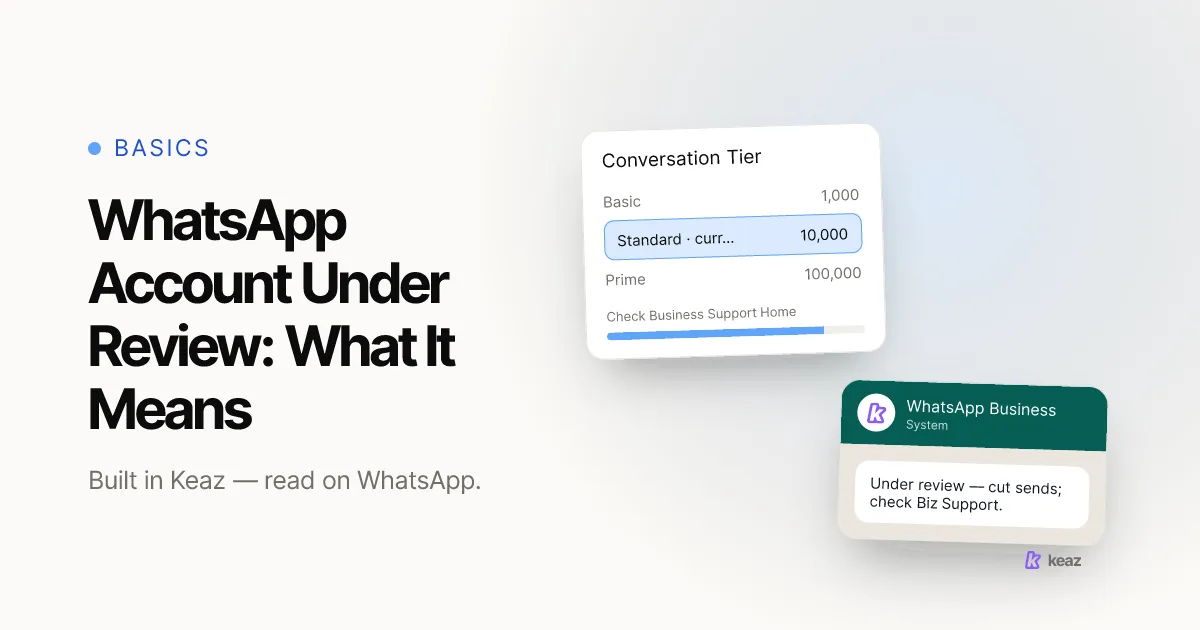
"Your account is under review" means Meta is looking at your WhatsApp Business Account and has not decided anything yet. It is not a ban and not a restriction — it is the state before either. The right response is unglamorous: cut your send volume, read the real status in Business Support Home, and do not register a second number or spin up a second account. That last reflex is the one that reliably makes things worse.
- 3 account states — under review, restricted, banned — mean three different things and call for three different responses.
- 24 to 48 hours is what Meta gives as the typical time for an appeal decision (Meta documentation, retrieved 2026-09-21).
- 1 place shows the status you can act on: Business Support Home in Meta Business Suite — not the WhatsApp app.
What does "account under review" actually mean?
The status tells you a process is running, not how it ends. Meta describes policy enforcement as a graduated system: accounts first receive a warning naming the policy they violated, and only repeated violations lead to messaging restrictions that gradually increase in duration (Meta, "WhatsApp Business Platform policy and spam enforcement", retrieved 2026-09-21). A review is the point at which Meta is still looking.
This matters because the advice written for the other two states is wrong here. If your account is banned, you appeal and wait for a decision. If your account is restricted, you operate at a reduced limit until the period ends. If you are under review, you still have some influence on the outcome — and that influence consists almost entirely of staying calm right now.
Under review, restricted or banned — where are you?
The three states get confused in practice because the in-product messages look similar. They are not:
- Under review. A process is running and no decision has been made. In many cases sending continues normally. Correct response: reduce volume, watch the status, do nothing dramatic.
- Restricted. A decision has been made and it expires. Meta names possible steps including a 1- or 3-day block on sending marketing, utility and authentication template messages, and a 5-, 7- or 30-day block on sending any messages (Meta, retrieved 2026-09-21). Correct response: fix the cause, sit out the period.
- Banned. Meta describes this as an account lock — an indefinite block on sending that can only be removed via an appeal. If the behaviour does not change, permanent removal from the platform follows.
If you are not sure which of the three you are in, that uncertainty is itself the answer to the next question: you have not opened Business Support Home yet.
Why does an account get reviewed in the first place?
Here the honest answer is unsatisfying: Meta does not publish the list of triggers that start an automated review. What Meta does publish is the list of violation categories and the principle behind them — repeated violations of the Business Messaging Policy, the Commerce Policy or the Business Terms of Service lead to restrictions, and Meta explicitly names "excessive negative feedback from users" as a reason in its own right (Meta, retrieved 2026-09-21). Anyone selling you a finished trigger list is guessing.
What you can measure is your number's quality rating. If it has been set to Flagged for the last seven days, WhatsApp decreases that number's messaging limit by one level, immediately (Meta, as of 2026-08-24). The rating is fed by what recipients do: block, report, ignore. It is therefore the one lever in this story a store genuinely holds.
The limit levels themselves are listed with dates and sources on our WhatsApp facts reference. We deliberately do not repeat them here — Meta can change them, and a second copy only goes stale.
What to do now — and what not to do
In this order:
- Open the real status. In Meta Business Suite: All tools → Business Support Home → Account Overview. It shows whether a restriction is active and which one. The WhatsApp app does not.
- Read the violation. Per Meta's own documentation, the entry names the policy violated, gives examples of allowed and disallowed content, states any active restrictions and explains how to appeal.
- Cut send volume. Pause marketing templates. Keep the transactional messages people are expecting — those generate almost no complaints.
- Appeal only if you are convinced no violation occurred. Use Request Review in Business Support Home. Meta gives 24 to 48 hours as the typical decision time; the appealed violation ends up either Unchanged or Reversed. Note that Meta says not all spam violations can be appealed.
- Check that your Business Manager admin addresses are current. Meta emails violation notices to every admin listed there. A stale address means you find out last.
And the list of moves that reliably make it worse: registering a new number, creating a second WhatsApp Business Account, rewriting template copy in a panic, or pushing volume back up "just to test whether it works again".
How do you know the review is over?
There is no message that says "done". What exists are four channels Meta uses to surface account status changes — worth knowing, because they move at different speeds.
- Business Support Home. The source you can rely on. It shows which restrictions are active, what happens on the next violation, and where a submitted appeal stands. Submitted requests move to the In Review tab.
- The Notifications Center in Business Manager, plus a banner in WhatsApp Manager.
- Email to every admin listed in Business Manager. This is why keeping those addresses current is not paperwork.
- The account_update webhook, if you are integrated. Meta sends policy violations in real time through it and, where applicable, the restriction type and duration.
In practice: if an appeal succeeds, Meta says the account returns to its previous status. If it fails, the violation stands as Unchanged and the period keeps running. An account with no active restriction left in Business Support Home is the best available evidence that the matter is closed.
Common mistakes
- Creating a second account. The most common and most expensive reflex. It does not solve the problem and raises the question of whether a restriction is being circumvented.
- Treating "under review" like a ban. Switching straight into recovery mode produces activity nobody asked for.
- Appealing with nothing in hand. A review request with no specific reason why the classification is wrong burns an attempt.
- Pushing volume back up as soon as the notice disappears. The quality rating recovers more slowly than the notice does.
- Not having your opt-in evidence ready. If complaints were the trigger, documented consent is the only thing you can put forward. How to set that up properly is covered in our WhatsApp opt-in guide.
How to end up here less often
Reviews almost always grow out of the same pattern: too many messages, too little relevance, all at the same moment. A single blast to the whole list in one minute is, from Meta's side, indistinguishable from what a spammer does — and the complaints it produces land directly in the quality rating.
That is exactly what Smart Activation in Keaz is built against: you define the condition, Keaz picks the send time per contact and spreads delivery in the background instead of firing everything at once. It is not a guarantee against a review, but it takes the edge off the most common trigger. The triggers and building blocks available for this are listed on the Keaz features page.
The second lever is the list itself. A cleanly collected, active opt-in with a clear promise about frequency and content produces fewer blocks than a list that grew fast — and blocks are the signal that ultimately drives the rating. A list built from a vague form, a giveaway import or a purchased file gets paid for later in the quality rating, not at the moment of collection.
The third lever is template categorisation. A message submitted as Utility but written promotionally gets re-categorised by Meta as Marketing — one of the violation types Meta names explicitly as "template misclassifications" in its enforcement documentation. Keeping the categories honest removes a whole trigger from the table.
"Under review" is the only one of the three account states where you can still influence the outcome — and the influence consists of doing less, not more. Read the status in Business Support Home, cut volume, get your opt-in evidence ready, and only then decide whether an appeal makes sense at all.
If you want to know what send volume your store realistically needs — and therefore how much headroom sits between you and the next quality dip — the Keaz forecast works it out from your Shopify numbers.
This is a summary of Meta's published platform rules rather than legal advice — have your own counsel review anything you rely on.
Frequently asked questions
How long does a WhatsApp account review take?
Can I keep sending messages while my account is under review?
Does registering a new number or a second account help?
Where do I see the real status of my WhatsApp Business Account?
Is "under review" the same as "restricted"?

Nils Spölgen
Founder at Keaz. Serial founder in chat marketing — built a local agency into Keaz, the WhatsApp marketing platform for Shopify. Bootstrapped the MVP, raised funding, and scaled to 200+ merchants in DACH. Writes about flows, opt-in & GDPR, Klaviyo, and realistic revenue benchmarks — prefers conservative math over impressive claims. View profile