In short: "WhatsApp Business" isn't one product but two — the free Business app for individuals and the WhatsApp Business API for teams and automation. The regular WhatsApp app is purely personal. For a Shopify store, the difference that matters is app vs. API.
- 3 variants: WhatsApp (personal) · Business app (small shops) · Business API (teams, automation, marketing)
- Business app: free, 1 account, no real marketing automation
- Business API: via a provider like Keaz — flows, newsletters, shared inbox, GDPR-compliant opt-in
What's the difference between WhatsApp, WhatsApp Business, and the Business API?
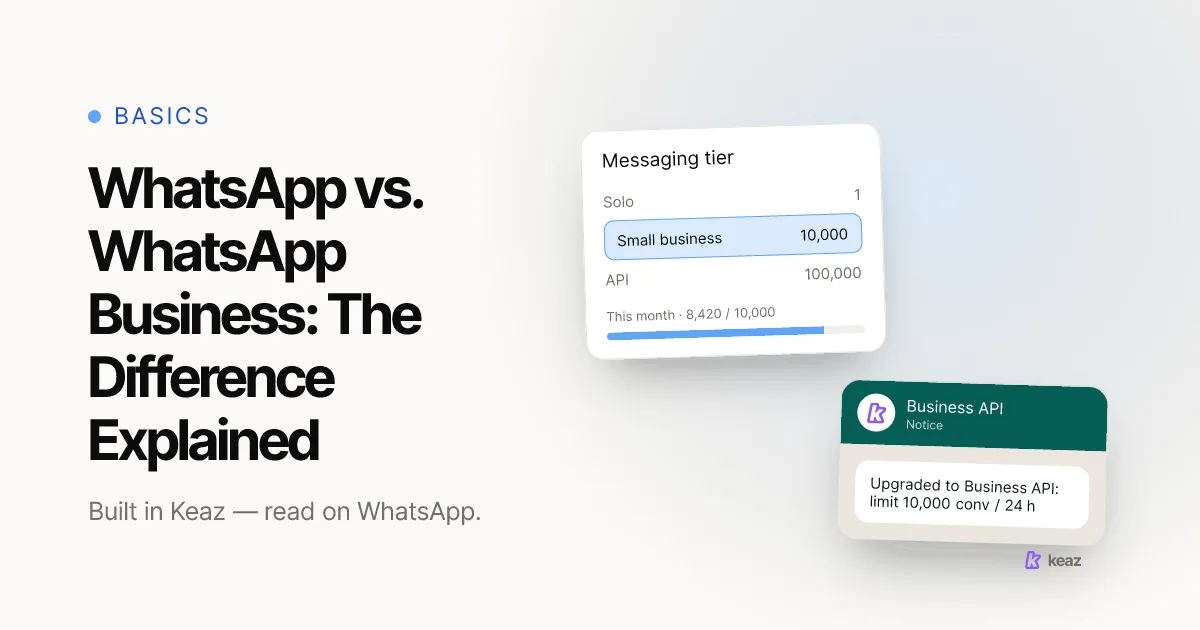
There are three variants with clearly different purposes. WhatsApp (the regular app) is for personal messaging. WhatsApp Business (the free app) targets sole traders and very small shops: a business profile, catalog, quick replies. The WhatsApp Business API is the platform for teams, automation and marketing — it has no app of its own and runs through an official provider (BSP) like Keaz.
Meta draws the same line in its own product pages. The WhatsApp Business app is described as built with the small business owner in mind, for one-to-one conversations throughout a purchase. The WhatsApp Business Platform is positioned instead around enterprise-level APIs, notifications, promotions and automated support flows (WhatsApp for Business, Meta — both retrieved 12 October 2026).
For a Shopify store the real decision is rarely "app or regular WhatsApp" but Business app vs. Business API — depending on whether you just reply occasionally or want to scale WhatsApp as a marketing and service channel.
WhatsApp Business app vs. the regular app — what changes?
The Business app is free and set up in minutes. Over the personal app you get a business profile (hours, address, website), a product catalog, labels to sort chats, and quick replies / away messages.
What it can't do: real marketing (newsletters/flows), multiple agents with roles, or a connection to your store system. In short: the Business app replaces personal use for a small business but stays a one-person tool.
When do you need the WhatsApp Business API?
As soon as WhatsApp should be more than occasional replies. Typical triggers:
- You want to send newsletters/broadcasts to opted-in contacts.
- You want automated flows (e.g. cart recovery, shipping updates) tied to Shopify events.
- Several people should work the same inbox with roles.
- You need documented, GDPR-compliant opt-in and reporting.
The API has no app of its own — you use it through a BSP like Keaz that provides access, a team inbox and automation.
WhatsApp vs. WhatsApp Business vs. API: side by side
The key differences at a glance:
- Purpose: WhatsApp – personal; Business app – small business; API – teams, marketing, automation.
- Cost: WhatsApp & Business app – free; API – a provider fee plus Meta's own fees, charged per delivered message and varying by recipient market and template category.
- Users: app variants – 1 account/a few devices; API – many team members with roles.
- Automation: apps – quick replies only; API – flows, newsletters, templates.
- Store integration: apps – none; API – Shopify events, catalog, tracking.
- Best for: WhatsApp – personal; Business app – solo/micro shop; API – growing Shopify stores.
Which one is right for a Shopify store?
If you're just starting and only answer the occasional query, the free Business app is enough. As soon as you want to use WhatsApp as a revenue channel — newsletters, automated flows, multiple agents — there's no way around the Business API.
The usual path: start with the app, move to the API once the channel pays off. Via a BSP like Keaz, API access incl. a team inbox and a first flow is set up in about 15 minutes.
Is WhatsApp Business free?
The WhatsApp Business app is free. The API is not: it carries a provider or platform fee plus Meta's own fees, which have been charged per delivered message since July 2025 and vary by recipient market and template category. The fair comparison isn't unit price but incremental revenue — intent-driven flows carry the higher price in most DTC setups. We break the cost question down in our guide to whether WhatsApp Business is free.
Bottom line: the regular WhatsApp app is personal, the Business app is a free tool for sole traders, and the Business API is the path for Shopify stores that use WhatsApp seriously as a marketing and service channel. If that is where you are heading, take a look at the Keaz team inbox, flows and newsletters, or read our guide to WhatsApp Business with multiple users. Want to see how much revenue WhatsApp could add? Run the forecast.
Frequently asked questions
Is WhatsApp Business the same as the Business API?
Can I send newsletters with the Business app?
Do I need technical know-how for the API?

Nils Spölgen
Founder at Keaz. Serial founder in chat marketing — built a local agency into Keaz, the WhatsApp marketing platform for Shopify. Bootstrapped the MVP, raised funding, and scaled to 200+ merchants in DACH. Writes about flows, opt-in & GDPR, Klaviyo, and realistic revenue benchmarks — prefers conservative math over impressive claims. View profile