Yes — the WhatsApp Business app is free to download and use. No, the WhatsApp Business Platform is not. Those are two different products carrying the same brand, and almost every confusing answer you will read about what WhatsApp costs comes from mixing them up. Which one you need turns on a single question: does a person type your messages, or does your shop send them?
- The app is free. Meta lists the WhatsApp Business app as a free download on the Google Play Store and the Apple App Store (WhatsApp for Business, retrieved 26 August 2026).
- The Platform has two cost lines. A monthly fee from your provider, plus Meta's fee per delivered message — priced by message category and by the recipient's country (Meta for Developers, retrieved 24 August 2026).
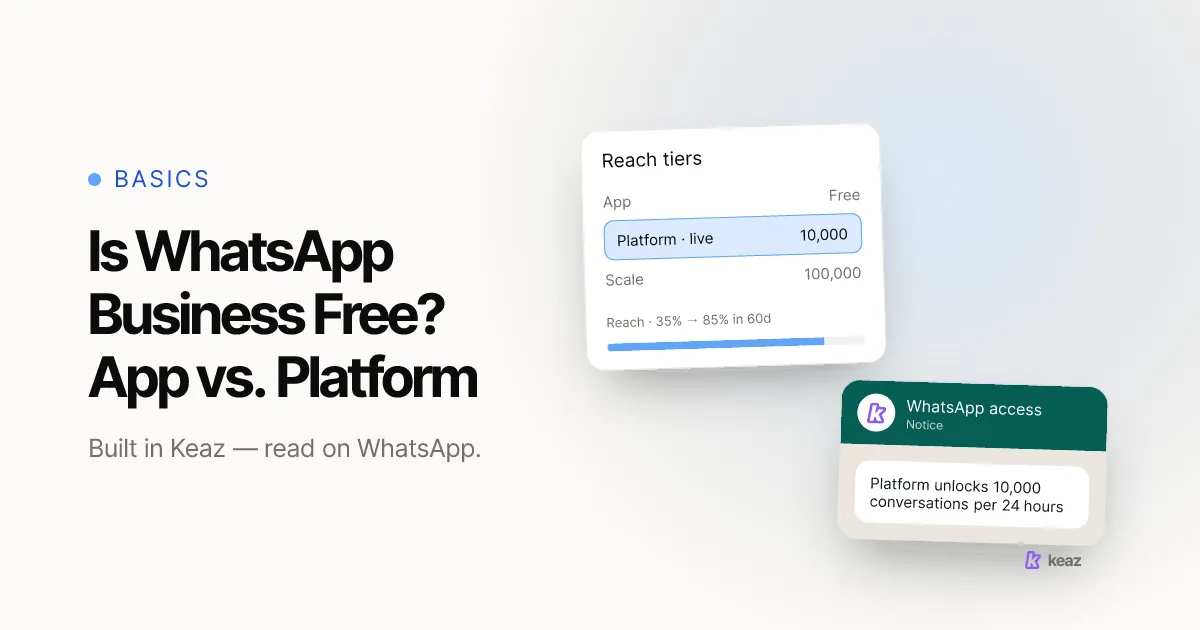
- Shops pay for reach, not features. Stores typically start with 35–55% of their last-12-months Shopify customers reachable on WhatsApp and pass 85% in around 60 days once the coverage strategies run. That number is what the paid path buys.
Is the WhatsApp Business app really free?
It is. Meta's own get-started page describes the WhatsApp Business app as "available for free" on both app stores (WhatsApp for Business, retrieved 26 August 2026). There is no subscription, no per-message charge and no minimum. You download it, register a number, fill in a business profile and start replying.
Two details are worth knowing before you decide that settles the question.
One paid thing does exist in the app world. Meta Verified is a separate paid subscription available to WhatsApp Business app users (WhatsApp FAQ, retrieved 24 August 2026). So "the app is free" and "there is something to pay for" are both true at once, which is one more reason the search results contradict each other.
The blue checkmark is not on this path at all. An Official Business Account — the checkmark next to your business name — is a WhatsApp Business Platform feature, and Meta's documentation states it is not available for numbers registered in the WhatsApp Business app (Meta for Developers, retrieved 24 August 2026). If a trust badge matters to you, the free app cannot deliver it. Our guide to WhatsApp business verification walks through what it does and does not unlock.
What the free app actually costs you is time. Every message is read and answered by a human on a phone. For a shop doing a handful of conversations a day that is fine, and it is genuinely the right answer more often than tool vendors admit. It stops being fine the moment you want the shop itself to send something.
What does the WhatsApp Business Platform cost?
Not free — and it helps to think in two lines rather than one price.
- Your provider's fee. A monthly platform fee from whoever connects you to WhatsApp. This is the line you compare between tools.
- Meta's messaging fee. Charged per delivered message, and the price depends on the message category and the country your customer is in (Meta for Developers, retrieved 24 August 2026). This line is the same whichever provider you pick, because it is Meta's, not theirs.
One correction worth making, because it is all over older articles: Meta replaced conversation-based pricing with per-message pricing on 1 July 2025 (same source). If you are reading a cost breakdown built on "per conversation", you are reading a description of a model Meta has retired.
We do not reproduce Meta's rates in this article, on purpose. Meta may change them at the start of a quarter, which means any figure printed in a blog post has a shelf life measured in weeks. Read the current numbers where they are maintained: Meta's pricing documentation carries the live rate card by country and category.
For your own bill, the numbers that matter are the ones in your account rather than any headline figure. In Keaz, the billing screen shows your plan fee, the Meta fees accrued this period and a country-by-country breakdown of what you actually sent. What our plans cost is listed on the Keaz home page.
Which one does your Shopify store need?
The honest rule of thumb has nothing to do with size and everything to do with who sends.
If a person answers each message, the free app is enough. If you want a message to go out because something happened in your shop — a cart was abandoned, an order shipped, a subscription payment failed — you need the Platform, because that requires a system connected to Shopify. A phone app has no way to know your checkout was abandoned.
The number that decides whether the paid path is worth it is Customer Contact Coverage: the share of your last-twelve-months Shopify customers you can reach on WhatsApp at all. Shops typically start between 35% and 55% and get past 85% in roughly 60 days once the coverage strategies are running. Everything else is downstream of that — an excellent automated flow reaching a third of your customers loses to a plain one reaching all of them.
Once coverage is there, the flows carry the revenue. Cart Recovery converts at 18–30% and accounts for around 40% of WhatsApp revenue in most shops; Back-in-Stock runs 25–40%. Those are the flows Keaz ships with, and the per-industry ranges sit on our industries page.
It is worth saying plainly that WhatsApp complements email rather than replacing it. Across Keaz audiences, 24% of customers are reachable by email only, 38% by both channels, 34% by WhatsApp only and 3% by neither — about a third of your customers are reachable on WhatsApp and nowhere else. Published benchmark bands put WhatsApp read rates above 90% against email open rates of 30–40%, at roughly 1.5× conversion rate on a shared audience; how we calculate those bands is documented separately.
If the two products are still blurry, our comparison of WhatsApp and WhatsApp Business sets them side by side, and WhatsApp Business with multiple users covers the other fork most shops hit early — how many people can work the same number. Getting onto the Platform itself is around 15 minutes of active work in our WhatsApp connection guide, plus up to two working days if Meta has not verified your business yet.
Common mistakes
Roughly in order of how often they cost a shop time.
- Treating "free app" and "paid Platform" as two prices for the same thing. They are different products. The comparison that matters is what each one lets you do, and only then what it costs.
- Budgeting a per-conversation figure from an older article. Per-message pricing replaced it on 1 July 2025. A spreadsheet built on the old model will not match your invoice.
- Assuming free means no obligations. Opt-in is required before you message anyone, and the opt-in has to name the business collecting it (Meta for Developers, retrieved 24 August 2026). That is identical on the free app and the paid Platform. Collecting WhatsApp opt-ins properly is the part worth getting right first.
- Chasing the blue checkmark on an app-registered number. It is not available there, so the effort lands nowhere.
- Budgeting only the provider fee. Two lines, not one. A quote that mentions only a monthly fee is incomplete, not cheap.
- Waiting for a single total-cost number before starting. There isn't one. What you pay per message depends on which categories you send and where your customers live, so the figure is a property of your own sending pattern.
So: the app is free, the Platform is not, and the split is not really about money. It is about whether your shop can send a message without someone picking up a phone. If a human answering every chat covers you, take the free app and spend the budget elsewhere. If you want a cart to chase itself, the paid path is the only one that reaches that behaviour — and the number to watch first is how much of your customer base you can reach at all, not the fee per message.
Last reviewed: August 2026. This is a summary of Meta's published rules and product terms as retrieved on the dates cited above, not legal advice — check the current documentation before relying on it, and have your own counsel review anything your customers will see.
Want the number instead of the rate card? Calculate what WhatsApp is worth for your shop — the forecast takes your Shopify data and turns it into a monthly figure.
Frequently asked questions
Is the WhatsApp Business app free forever?
Is the WhatsApp Business API free?
Can I run my Shopify store on the free app?
How much does Meta charge per message?
Do I have to pay for the blue checkmark?

Nils Spölgen
Founder at Keaz. Serial founder in chat marketing — built a local agency into Keaz, the WhatsApp marketing platform for Shopify. Bootstrapped the MVP, raised funding, and scaled to 200+ merchants in DACH. Writes about flows, opt-in & GDPR, Klaviyo, and realistic revenue benchmarks — prefers conservative math over impressive claims. View profile