Beauty is the vertical where WhatsApp pays back fastest, and the reason is the refill cycle. A serum runs out on a schedule, so a reminder that arrives at the right moment meets an intention the customer already has. Across Keaz customers in beauty and skincare, adding the channel is worth 12-18% more revenue over 90 days than an email-only baseline.
The short version:
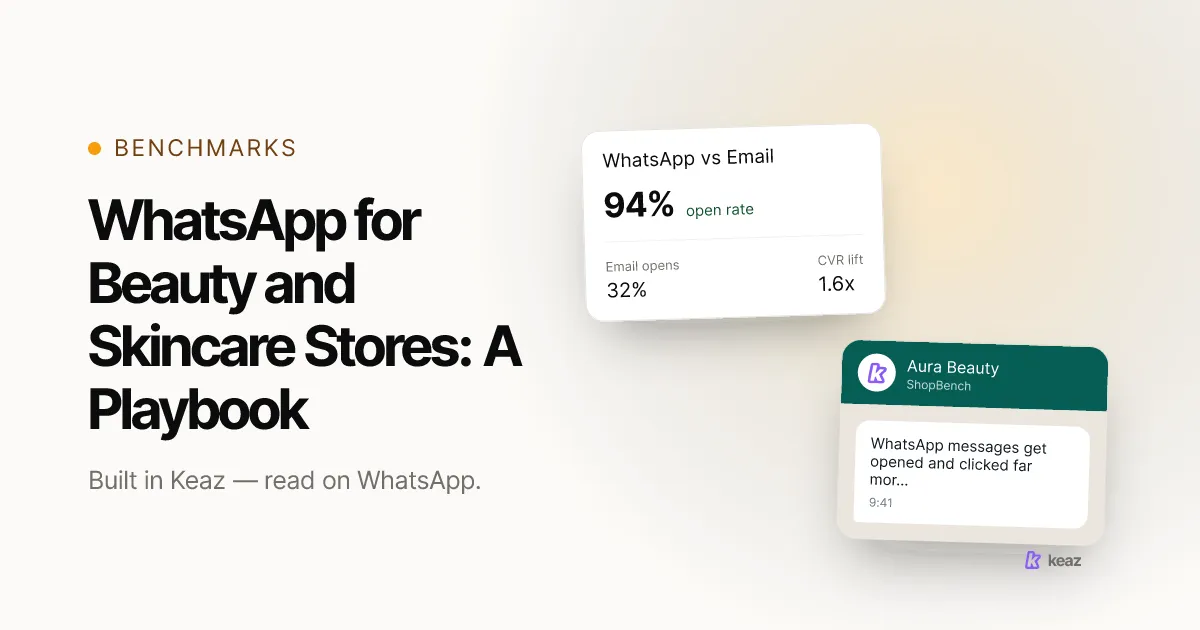
- 94% open rate and 38% click-through on WhatsApp, against roughly 32% open and 3% click-through on email.
- Three flows carry this vertical: Re-Order Reminder at 11.4%, Cart Recovery at 8.7%, Post-Purchase Review at 6.2%.
- 8-12% of clicks become purchases, and 45% of customers buy again inside 90 days.
Why does WhatsApp work so well for beauty stores?
Three things about this vertical line up in the channel's favour.
- Short, predictable cycles. A cleanser, a serum, a refill pack — consumption is regular enough that you can time a message to it instead of guessing.
- A photo-led decision. Customers want to see the texture, the shade, the routine. A chat thread carries images and follow-up questions better than an inbox does.
- People answer. Skin-type questions arrive as replies, and a reply is a sale you can close by hand.
The first-party numbers we publish for this vertical: a 94% open rate against roughly 32% on email, 38% click-through against roughly 3%, 8-12% of clicks converting to a purchase, and 45% of customers buying again within 90 days. The full picture, including the message templates we calibrate per vertical, sits on our beauty benchmarks.
None of this replaces email. Across our customer base, 24% of customers are reachable by email only, 34% only on WhatsApp and 38% on both — and on that shared group conversion moves from 2.1% to 4.5%, roughly 1.5 times. Where each channel wins is set out in our channel comparison. Both channels stay.
Which three flows should a beauty store switch on first?
In this order. Each one is triggered by a Shopify event, so you are switching on logic rather than building it.
- Re-Order Reminder — 11.4%. It fires when a customer is near the end of their typical cycle, with one tap to buy the same thing again. In beauty this is the largest pool you have, because most of the catalogue is consumable. The trigger is documented in Flow trigger: Contact Purchase.
- Cart Recovery — 8.7%. It catches a checkout that was started and never finished, while the intent is still alive. Two messages are enough; the timing and the copy are covered in our cart recovery guide, and the trigger in Flow trigger: Abandoned Checkout.
- Post-Purchase Review — 6.2%. It asks how the routine is going a couple of weeks in. That earns you reviews, and the answers tell you which product needs a better description before it needs a discount.
Every flow is a message template you edit, with timing and conditions you control. All of them are described under features. Resist switching on all three in week one: one flow with 30 days of data behind it tells you more than three flows you cannot read apart.
How many of your customers can you actually reach?
A flow can only message the customers you can reach, so coverage sets the ceiling on every number above it.
- Read your Customer Contact Coverage. That is the share of your last-12-months customers you have a phone number for. Most shops start between 35% and 55%, and reach 85%+ within about 60 days.
- Encourage the phone field at checkout. Capture typically moves from 22% to 65-70% once the field is encouraged rather than buried. It is the single biggest lever you have.
- Re-permission the customers you already have. Smart Activation asks historic customers — those whose last order is more than 12 months old — to opt in, throttled to at most twice a year. In an established beauty shop that list is usually larger than a quarter of new orders.
- Get the opt-in right before any of it. Every recipient needs explicit, documented and revocable consent, given for messaging specifically. Our opt-in guide shows how to ask without losing checkout conversion.
This is a summary rather than legal advice — have your own counsel review how you collect, record and honour consent.
What should the messages actually say?
- Name the product and the cycle. "Your hydrating serum usually runs out around now" is a shop that pays attention. "Shop our bestsellers" is a broadcast.
- One link, straight to the reorder. Not the homepage, not a category page. The tap should be the purchase.
- A reason that is not automatically a discount. A restock, a shade returning, a shipping cut-off before the weekend — or the offer to answer the question that stopped them.
- Hold the discount back for the second message, if at all. Discount every reminder and customers learn to wait for the code.
- Invite the reply. "Is this one still right for my skin in winter?" is not an objection, it is a warm lead — provided somebody answers it the same day.
What does 90 days typically add?
The band we publish for beauty is 12-18% more revenue over 90 days than an email-only baseline, based on Keaz customers in this vertical, and it is deliberately the defensible end rather than the best case. How the ranges are derived is set out in how the forecast is calculated.
A worked example, not a customer case. The arithmetic is the part worth copying — run it with your own figures.
- 3,000 customers bought in the last 12 months and you have phone numbers for 45% of them, so 1,350 are reachable.
- In a given month, roughly 500 of those are near the end of a refill cycle — the Re-Order Reminder population.
- At 11.4%, that is 57 orders. At the €52 average order value we see in beauty, about €2,960 from one flow in one month.
- Raising coverage from 45% to 85% takes the reachable base to roughly 2,550 and close to doubles that figure — which is why coverage work usually beats copy work.
The category will not do this for you. German online drugstore revenue was €3.345 billion in 2024, down 0.1% on the year, while e-commerce with goods as a whole grew 1.1% to €80.6 billion (bevh, Interaktiver Handel in Deutschland, January 2025). In a flat category, revenue from customers you already have is the cheapest growth on offer. To run the numbers with your own customer base instead of a benchmark, the forecast calculates it.
Common mistakes
- Running WhatsApp as a second email newsletter. Same copy, same weekly slot. The channel's advantage is timing, and a fixed calendar throws it away.
- One cadence for the whole catalogue. A daily cleanser and a lipstick do not share a cycle. Send at one frequency to both and you are early for one and late for the other.
- Discounting on every message. At a €52 average order value, a habitual 10% off is a large share of the margin, and it trains the list to wait.
- Sending without a documented opt-in. Consent is channel-specific: an email subscription does not carry over to messaging.
- Fixing the copy before the coverage. A better message to 1,350 people loses to the same message to 2,550.
- Measuring read rates instead of revenue. Read rates here are high enough to be uninformative. Revenue per send is the number that changes a decision.
- Leaving replies unanswered. In beauty the reply rate is the point. A question about skin type that nobody answers is worse than a message you never sent.
Beauty rewards this channel because the product runs out and the customer answers. Start with coverage, switch on Re-Order Reminder, keep email running alongside it, and read revenue per send rather than read rates. That is the whole playbook.
What would this be worth in your shop? The forecast runs the numbers on your own customer base and coverage.
Frequently asked questions
Which flow should a skincare store switch on first?
Do I need a separate opt-in if the customer already gets my emails?
How many messages a month is too many for a beauty list?
Does this work for a store with fewer than 1,000 customers?
What if my catalogue is mostly makeup rather than skincare?
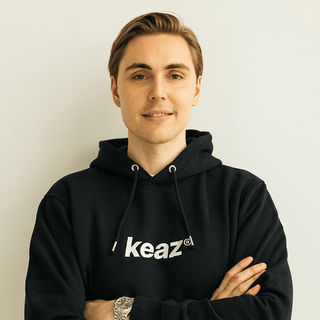
Nils Spölgen
Founder at Keaz. Serial founder in chat marketing — built a local agency into Keaz, the WhatsApp marketing platform for Shopify. Bootstrapped the MVP, raised funding, and scaled to 200+ merchants in DACH. Writes about flows, opt-in & GDPR, Klaviyo, and realistic revenue benchmarks — prefers conservative math over impressive claims. View profile