Churn rate is the share of the customers you had at the start of a period who were gone by the end of it. For a subscription business it is the clearest number on the dashboard, because a cancellation is an event you can count. A Shopify store has no such event — nobody cancels, they just stop — so the figure you calculate depends entirely on a measurement window you chose yourself. That does not make it useless. It makes it a number you have to define before you can read it.
Three numbers worth having in front of you first:
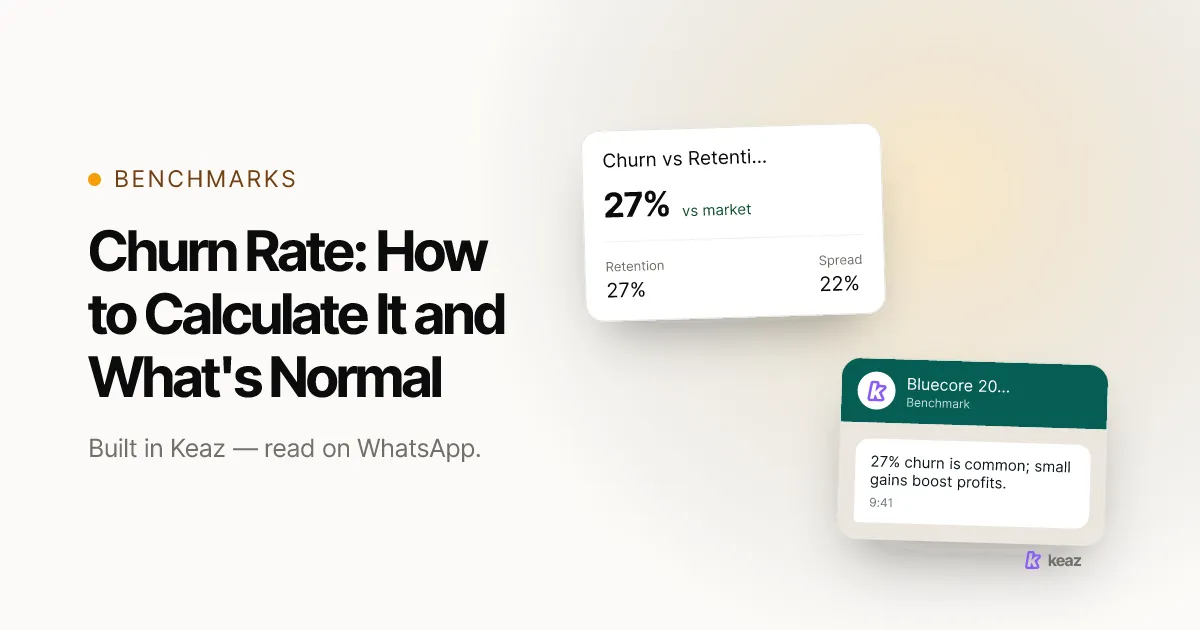
- 27.4% is the total customer retention rate across seven retail verticals in Bluecore's 2025 Customer Growth Benchmarks Report, as published by Shopify (retrieved 2026-09-11). Read as churn, that is close to 73% — and for retail it is ordinary, not a crisis.
- 19.1% to 41.2% is the spread between the weakest and strongest vertical in that same data. Across a range that wide, a single industry-standard churn rate does not exist.
- 5% is the retention improvement that Frederick Reichheld's Bain research associates with a 25% to 95% profit increase, as cited by Harvard Business Review (2014). Small movements on this metric have outsized consequences, which is why it is worth measuring properly.
What is churn rate, and what does it actually measure?
Churn rate answers one question: of the customers who were already yours, what proportion did not come back? It is the mirror image of retention rate, and the two always add up to 100% over the same window and the same definition.
There are two different churn questions, and confusing them is the most expensive mistake in this whole area:
- Customer churn counts people. It treats a customer who spent 20 euros the same as one who spent 2,000. It tells you how leaky the base is.
- Revenue churn counts money. It weights every departure by what that customer was worth. It tells you how much the leak costs.
A store can lose a third of its customers and almost none of its revenue, if the ones who left were one-time discount buyers. It can also lose 5% of its customers and a quarter of its revenue, if those five percent were the repeat buyers. Customer churn on its own will not distinguish those two situations, and they call for opposite responses.
The deeper problem in commerce is the missing event. In a subscription, churn has a date attached to it. In a shop, a customer who has not ordered for eight months may be gone, or may simply be on a nine-month cycle. You are not observing a departure; you are inferring one from silence. Everything below follows from that. If you want the two commerce-native metrics that do not have this problem, they are set out in our guide to ecommerce customer retention.
How do you calculate churn rate?
The calculation runs off order data you already hold in Shopify. You do not need a tool for the first pass.
- Choose a period that matches your repurchase cycle — one to two typical cycles. Not a calendar quarter because it is convenient.
- Count the customers you had at the start of the period (S).
- Count the customers you had at the end (E).
- Count the new customers acquired during it (N).
- Churn rate = ((S − E + N) ÷ S) × 100.
Worked through: 10,000 customers at the start of the month, 12,000 at the end, 2,300 acquired along the way. ((10,000 − 12,000 + 2,300) ÷ 10,000) × 100 = 3%. The base grew and you still lost three percent of the people you started with — which is exactly the fact that a headline growth number hides.
For revenue churn, run the same window but replace customer counts with the revenue those customers produced in the comparable prior period. The formula is identical; only the unit changes. Do both at least once. If they disagree sharply, the disagreement is the finding.
Two notes that decide whether the output is meaningful. Subtracting N is not optional — leave new customers in and a strong acquisition month will read as a strong retention month. And the window has to stay fixed between periods, or you are comparing two different measurements. How Keaz derives its own figures from shop data is documented in the Forecast methodology.
What is a good churn rate?
There is no single answer, and any source that gives you one without naming a vertical is selling something. What does exist is published bands you can place yourself against. The figures below are third-party benchmarks, quoted as bands rather than targets.
Retention across seven retail verticals, from Bluecore's 2025 Customer Growth Benchmarks Report as published by Shopify (2026), retrieved 2026-09-11. Subtract each from 100 to read it as churn:
- Health and beauty — 41.2% retained, so roughly 59% churn.
- Department stores — 36.2% retained.
- Apparel — 31.7% retained.
- Sports and hobbies — 27.8% retained.
- Footwear — 22.2% retained.
- Home goods — 21.4% retained.
- Jewelry and accessories — 19.1% retained, so roughly 81% churn.
Across the whole sample the retention rate was 27.4%. Subscription commerce sits in a different place again: Recurly's 2026 State of Subscriptions report, cited in the same Shopify article, found 52% of consumers had cancelled a subscription in the previous twelve months.
Use these to sanity-check, not to set a target. Each study defines its window and its customer base differently, and none of them used your catalogue or your repurchase cycle. The comparison that actually tells you something is against your own figure from the same window last year.
Why churn is the wrong first question for most shops
Here is the uncomfortable part. For a store without subscriptions, churn rate is a lagging, low-resolution summary of something you could be measuring directly — and by the time it moves, the quarter it describes is over.
Three questions get you further, in this order:
- Does a second order happen at all? Repeat purchase rate answers this, and it is the number most first-time-heavy shops are actually failing on.
- What is a retained customer worth? That is customer lifetime value, and it is the figure worth optimising against, because it prices the decision rather than describing it.
- Which customers are drifting right now? A segment of people who are one cycle overdue is actionable this week. A churn percentage for last quarter is not.
Churn rate still earns its place as a board-level summary and as the honest framing for replenishment and subscription catalogues, where a missed reorder really is a departure. It just should not be the first thing you build a dashboard around. If you want the revenue side answered from your own numbers before you build anything, the Keaz Forecast calculates it from your Shopify data.
Which levers actually lower it?
Churn is lowered by earning the next order, not by watching the metric. Three interventions do most of the work for a Shopify store, and each is a separate build.
- Make the second order happen sooner. The gap between order one and order two is where most of the loss sits. A message that fires off the purchase itself reaches people while the brand is still fresh — the Contact Purchase trigger in the help center covers the setup.
- Catch the reorder before it is missed. If your product runs out on a predictable schedule, churn is mostly bad timing rather than lost affection. WhatsApp for subscription brands deals with that case and with cancel-save.
- Aim, do not broadcast. A message to everyone costs you the people who did not need it. Segmenting by recency and value first makes the other two levers land, and the message templates and flows available are listed under features.
Then make the result provable. Give every flow its own discount code, because attribution works by matching a redeemed code back to the message that sent it, and two flows sharing a code produce one unusable figure — revenue tracking: one discount code per flow explains it.
One channel note, because it comes up every time: WhatsApp complements email, it does not replace it. It earns its place on time-sensitive prompts — a reorder due this week, a subscription about to fail — where visibility matters more than length. Every message needs explicit, documented opt-in.
Common mistakes
Each of these has produced a confident churn number that later turned out to mean nothing.
- Borrowing a SaaS measurement window. Monthly churn is the convention in subscription software and meaningless for a catalogue people buy from twice a year. Your repurchase cycle sets the window, not the dashboard default.
- Leaving new customers in the formula. Subtracting N is the whole point. Skip it and acquisition quietly flatters your churn rate.
- Reporting customer churn and acting as if it were revenue churn. Losing a hundred one-time buyers and losing your ten best customers can produce the same percentage and require completely different responses.
- Treating a published benchmark as a target. Every study defines its window differently. A number from someone else's methodology is context, not a goal.
- Declaring a customer churned too early. Mark someone inactive at 90 days when your cycle is six months and you will spend a discount winning back a customer who was coming anyway.
- Reading a percentage without the count behind it. At small order volumes a handful of customers moves the rate several points. Check the base before you act on the ratio.
- Answering a high churn rate with more frequency. More messages is not better timing. On WhatsApp it is also the fastest route to being blocked, and a blocked contact is lost permanently.
Churn rate is worth calculating and not worth worshipping. Define the window from your own repurchase cycle, subtract the customers you acquired, run it once for people and once for revenue, and read the published benchmarks as bands rather than targets. Then spend your attention on the second order, which is the thing that actually moves the number. The research on retention economics, summarised by Harvard Business Review (2014), retrieved 2026-09-11, is that small improvements here compound unusually well.
If you want the revenue behind your own retention answered before you build anything, the Keaz Forecast calculates it from your Shopify data.
Frequently asked questions
What is a good churn rate for an online shop?
What is the churn rate formula?
What is the difference between churn rate and retention rate?
How is churn different for a shop without subscriptions?
Does lowering churn actually matter financially?

Nils Spölgen
Founder at Keaz. Serial founder in chat marketing — built a local agency into Keaz, the WhatsApp marketing platform for Shopify. Bootstrapped the MVP, raised funding, and scaled to 200+ merchants in DACH. Writes about flows, opt-in & GDPR, Klaviyo, and realistic revenue benchmarks — prefers conservative math over impressive claims. View profile