If you are comparing loyalty apps for your Shopify store, start with a diagnosis rather than a tool. A points program only works on customers you can still reach — it hands them a balance, and a balance is worth nothing to someone who never hears from you again. Most small stores that reach for loyalty points are trying to fix a second-order problem that is really a reach problem. Fix reach first, then decide whether an incentive is still the missing piece.
- Around two-thirds of established loyalty programs fail to deliver value, and some erode it (McKinsey, 2021).
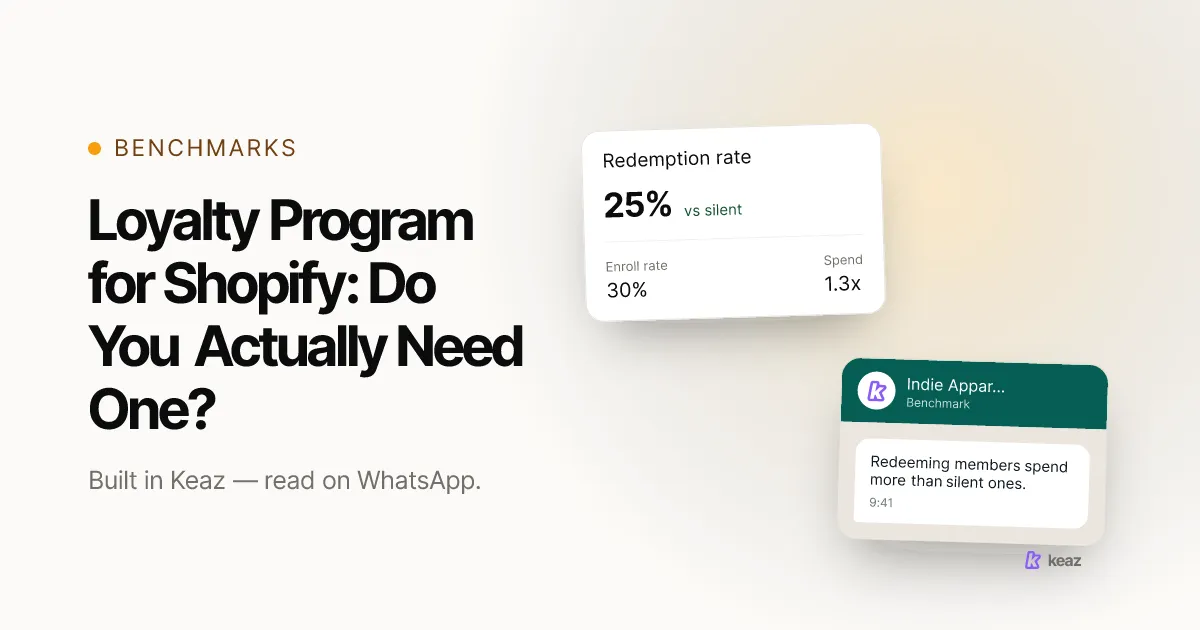
- Members who actually redeem spend 25% more than members who enrolled and went quiet — the value sits in redemption, not in sign-ups (McKinsey, 2021).
- Acquiring a new customer is put at five to 25 times the cost of keeping one (Amy Gallo, The Value of Keeping the Right Customers, Harvard Business Review, 2014, retrieved 2026-10-01), which is why a reliable second order beats a points balance.
What does a loyalty program actually do?
A points program does three jobs at once, and most stores buy it for the first while quietly needing the other two:
- It gives a reason to come back that is not a discount on this order — the reward sits in the future.
- It identifies the customer at checkout, so purchases attach to a person instead of to an anonymous order.
- It produces a reason to message someone — a balance, an expiry, a tier that is one order away.
On Shopify this normally arrives as a dedicated app that issues the currency, holds every balance and enforces the redemption rules. That ledger is the product you are buying. Everything else — the reminders, the expiry warnings, the tier-upgrade congratulations — is messaging layered on top of it. Keep the two separate in your head, because the messaging layer is what decides whether the ledger is ever used, and it is the part most stores are weakest at.
Why do most loyalty programs underperform?
Because enrolment is not engagement. McKinsey put it plainly in 2021: around two-thirds of established loyalty programs fail to deliver value, and many actively erode it (José Carluccio, Oren Eizenman and Phyllis Rothschild, Next in loyalty: Eight levers to turn customers into fans, McKinsey, 2021, retrieved 2026-10-01). These are figures from large programs; treat them as a direction of travel rather than a prediction for a shop with 2,000 customers.
The failure has a name. The same analysis describes breakage: members who never redeem, or who do not know the points exist, until the balance expires. Breakage flatters the balance sheet and hides the problem, because an unredeemed point is a customer who stopped paying attention.
The upside is real but conditional. In the same work, a typical active member spends about 10% more than someone enrolled but inactive, while members who actually redeem spend about 25% more, and top-performing programs lift revenue from redeeming customers by 15–25% a year. Read the condition carefully: every one of those numbers is earned at redemption. Redemption depends on the customer remembering, and remembering depends on being reminded — which is a messaging capability, not a ledger feature.
Is your problem the incentive or the reach?
Three numbers from your own Shopify data separate the two, and you can get them in an afternoon:
- Repeat rate: of the customers who placed a first order twelve months ago, what share has placed a second?
- Reachable share: of those same customers, how many can you contact on a channel they consented to, and how many of those messages are actually opened?
- Response: when a reachable past customer does hear from you, what share orders within 30 days?
If the second number is the weak one, you have a reach problem and points will not touch it. You would be funding a reward that the customer never learns they have earned. If the first two are healthy and the third is poor — people hear from you, and still do not buy — then the incentive is genuinely missing, and a loyalty program is a reasonable answer.
Both paths need the same arithmetic underneath them, because a reward only makes sense if you know what a returning customer is worth. Our guide to calculating customer lifetime value walks through the calculation, and the Keaz Forecast models it against your own order history rather than a benchmark table.
When is a points program the right tool?
There are shops where a real loyalty program earns its keep. The pattern is consistent:
- High purchase frequency on a modest basket — coffee, supplements, pet food, consumables people buy monthly. Points accumulate fast enough to feel real.
- A catalogue wide enough that a reward is a choice rather than a token. One product line makes every redemption the same redemption.
- Margin that survives giving some of it away, permanently, to customers who were already loyal.
- Someone who will run it for a year. A program nobody tends becomes a liability with a login screen.
- A need to identify the same customer across online and offline tills, where the loyalty ID is doing work no flow can do.
And the limit on our side, stated plainly: Keaz is not a loyalty platform. It does not issue points, maintain tiers or hold a rewards balance, and no flow in it can be made to do that. Keaz is the WhatsApp channel — segments, flows triggered by Shopify events, newsletters and a shared inbox. If you decide you want a points ledger, you need a loyalty app for it. What we can tell you is whether the customers that ledger would reward are people you can still reach, and our post on turning one order into three covers the alternative in full.
How do you run the repeat-order alternative in Keaz?
The cheaper experiment is to earn the second order without issuing a currency. Five steps:
- Collect the phone number with explicit, documented consent at checkout. Without it there is no channel, and the rest of the list is theory.
- Build a flow on the Contact Purchase trigger, so every completed Shopify order starts the sequence by itself. The setup, the filters and the Shopify prerequisites are in the Contact Purchase trigger help article.
- Add a delay that matches how long the product lasts. Keaz flows start from events, and time passing is not an event — but a delay inside a purchase-triggered flow gives you reorder timing without a lapse trigger. Thirty days for coffee, ninety for skincare, measured from your own repeat gaps rather than copied.
- Filter on what they actually bought. A reorder nudge that names the product beats a points balance that names a number, and the trigger can branch on products, order value and purchase count.
- Hold the discount back. Lead with the restock, the refill or the matching product; keep money for the contacts who ignored the first message. The full set of blocks and triggers is on the Keaz features page.
WhatsApp complements email here rather than replacing it. The short reorder nudge suits a chat thread; the seasonal catalogue still belongs in an inbox. Whichever carries it, consent is per channel, not per customer.
How do you tell whether it worked?
This is the step a loyalty program makes genuinely hard and a flow makes easy. Give the flow its own discount code and Keaz attributes the resulting orders to that flow rather than to the month — the revenue tracking help article explains how the code is created and pulled into the message.
Keep roughly 10% of the eligible contacts out of the flow as a holdout. Some customers reorder on their own, and without a holdout you will credit the flow for all of them and scale something you have not measured. Then two numbers are enough: the difference in repeat rate between the messaged group and the holdout, and revenue per recipient, which keeps you honest when a high response rate turns out to be made of small discounted orders.
Run that for one quarter before you buy a loyalty app. If the flow closes the gap, the points were never the missing piece. If it does not move, you now have clean evidence that the incentive is what is missing — and a much better brief for choosing a program.
Common mistakes
- Buying a loyalty app before measuring the reachable share. Points cannot be redeemed by someone you cannot message.
- Reporting enrolments. Sign-ups are the cheapest number in the program and the least informative; redemption is where the uplift was measured.
- Setting a redemption threshold your average customer cannot reach. A reward four orders away is not an incentive, it is a decoration.
- Treating breakage as profit. Unredeemed points are customers who stopped listening, and they stop buying shortly afterwards.
- Rewarding customers who would have returned anyway. Without a holdout, every repeat order looks like the program working.
- Running a program nobody owns. The ledger keeps accruing liability whether or not anyone is sending the reminders that make it pay.
A loyalty program is an incentive, and an incentive only works on someone who is listening. Before you add a currency to your Shopify store, check the three numbers: how many customers come back, how many you can still reach with consent, and what happens when you do reach them. If reach is the weak one, a purchase-triggered reorder flow fixes the actual problem for a fraction of the cost and tells you, with a holdout, whether it worked. If reach is healthy and they still do not return, buy the points program — and now you will know what you are buying it for.
To see what a returning customer is actually worth in your shop before you commit to either, run the Keaz Forecast on your own order data.
Frequently asked questions
Does Keaz have a loyalty program feature?
Is a loyalty program worth it for a small Shopify store?
What is breakage in a loyalty program?
Can a WhatsApp flow replace a loyalty program?
Nils Spölgen
Founder at Keaz. Serial founder in chat marketing — built a local agency into Keaz, the WhatsApp marketing platform for Shopify. Bootstrapped the MVP, raised funding, and scaled to 200+ merchants in DACH. Writes about flows, opt-in & GDPR, Klaviyo, and realistic revenue benchmarks — prefers conservative math over impressive claims. View profile