Customer retention software has to do exactly three jobs: identify the customers who are about to stop buying, reach them on a channel they actually open, and prove that the order which followed came from that message. Almost every tool sold under the label does one of the three well, a second one adequately, and leaves the third to you. So the useful question before buying is not which vendor has the longest feature list — it is which of the three jobs your current stack already covers, because the gap is the only thing you are genuinely shopping for.
- Three jobs, one shortlist. Score every candidate on identify, reach and attribute. A tool that covers two of the three leaves you a manual step that will quietly stop happening by week six.
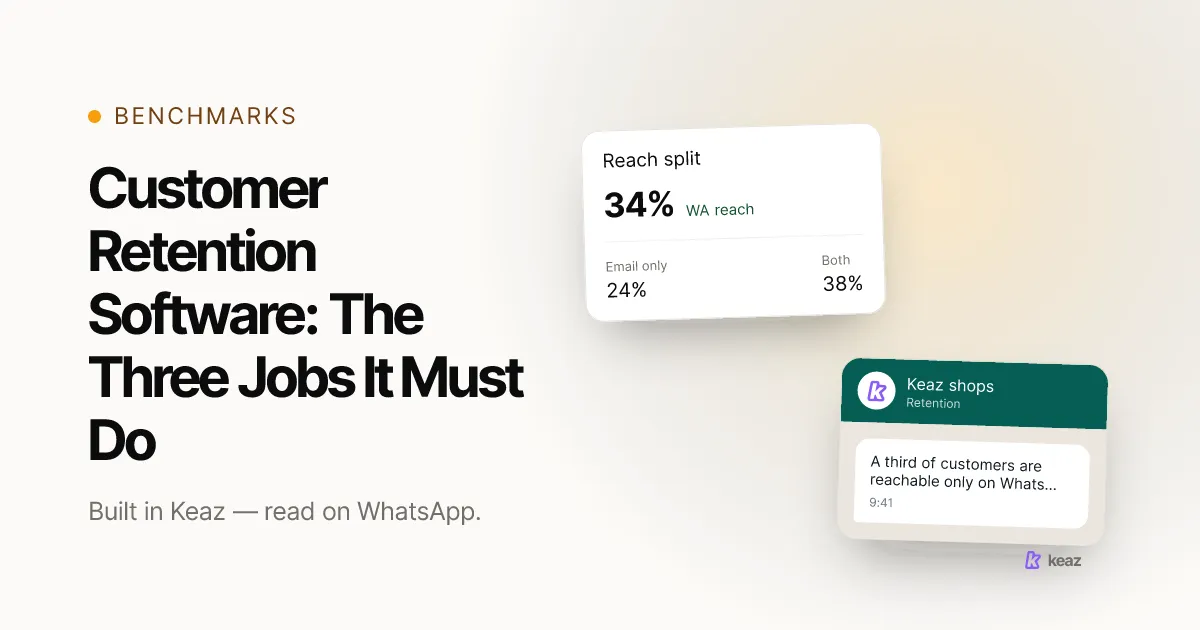
- One channel will not carry it. Across Keaz shops the audience splits 24% email only, 38% both, 34% WhatsApp only and 3% neither — about a third of your customers are reachable on WhatsApp and nowhere else.
- Fix reach before you buy reach. Shops typically start with 35–55% of their last-12-months customers contactable on WhatsApp. No retention tool can message the other half.
What does customer retention software actually have to do?
Retention is worth doing, and the number everyone quotes to prove it is narrower than it looks. The claim that a 5% lift in retention raises profits by 25–95% traces back to Frederick Reichheld and W. Earl Sasser's Zero Defections: Quality Comes to Services (Harvard Business Review, 1990, retrieved 2026-09-28), where the upper end came from one bank's branch system rather than from retail. Harvard Business Review's later The Value of Keeping the Right Customers (2014, retrieved 2026-09-28) restates the case more carefully. Treat the headline figure as direction, not as a forecast for your shop — and note that a vendor quoting it as a flat promise has told you something about how they sell.
Strip the category down and three jobs remain.
- Identify. Turn order history into a cohort you can act on: who bought once and never returned, who is overdue against their own repurchase cycle, who used to order monthly and has gone quiet. This is a segmentation job, and it runs on data you already own.
- Reach. Get a message in front of that cohort. This is where most retention tools are weakest, because reach is not a feature you can build — it depends on how many of your customers you can actually contact, and on whether the channel gets opened.
- Attribute. Show that the order which followed was caused by the message. Without this the first two jobs produce activity rather than evidence, and the budget conversation next quarter goes badly.
The three are sequential and each one caps the next. Perfect segmentation aimed at contacts you cannot reach produces nothing. Excellent reach without attribution produces a number nobody trusts. When you compare tools, compare them in this order rather than by module count. The Keaz side of each job is listed under features.
Which of the three jobs does your stack already cover?
Most shops discover they already own one and a half of the three. Run these three checks against your current setup before you look at a single vendor page.
- Can you produce the at-risk cohort today? Not a report — a list you can message. If building it means exporting a CSV and filtering it by hand, you have the data but not the job. In Keaz this is the Segment Builder, and the conditions that matter are days since last order, order count and lifetime value.
- What share of that cohort can you actually contact? Count the customers on the list who have a valid phone number or an unexpired email consent, and divide by the list length. This is the number that decides what any tool can do for you, and it is usually lower than expected. Our own starting benchmark is 35–55% of last-12-months customers reachable on WhatsApp, which rises to 85%+ in roughly 60 days once the checkout field, the welcome message and the after-checkout prompt are in place.
- Can you name the revenue from last quarter's retention work? If the answer is a total for the channel rather than a figure per campaign, attribution is your gap. That is a setup problem more often than a tooling problem — see the next section.
Two of three checks passing means you are buying one job, not a platform, and the shortlist shrinks accordingly. It also means the honest comparison is against your own baseline: work out your churn rate first, so the tool has something to be measured against.
How do you prove a retention tool actually worked?
Attribution is the job most often skipped at setup and most often demanded six months later. Three habits make a retention tool provable.
- One discount code per flow. Attribution in Keaz works by matching a redeemed code back to the message that sent it, so two flows sharing a code produce one figure that belongs to neither. Revenue tracking: one discount code per flow covers the setup.
- Compare against the same window last year. Retail demand is seasonal in both directions, and a month-on-month comparison in a seasonal catalogue mostly measures the season.
- Wait a full repurchase cycle before judging. A reorder prompt for something people buy twice a year cannot be evaluated in six weeks, however encouraging the early figures look.
There is a measurement trap worth naming. A retention tool that only ever messages your most loyal customers will report excellent numbers, because those people were going to order anyway. Hold out a slice of the cohort and compare, or accept that the figure is a description rather than a result. The underlying definitions — retention rate against repeat purchase rate, and which window to use — are set out in ecommerce customer retention.
Where does WhatsApp fit in a retention stack?
Reach is the job where the honest answer is a mix. WhatsApp complements email; it does not replace it, and a retention stack that bets everything on one channel is choosing which third of its customers to lose.
- Email keeps the long-form and the low-urgency work. Newsletters, catalogue drops, anything a reader may want to scroll back to later.
- WhatsApp earns the time-sensitive prompts. A cart still warm, a reorder due this week, a back-in-stock the customer asked for. Visibility matters more than length there.
- Roughly a third of your audience sits on WhatsApp only. On the 24 / 38 / 34 / 3 split above, those 34% are invisible to an email-only retention programme no matter how good the segmentation is.
Whichever channel you add, the permission comes first: every WhatsApp message needs explicit, documented, revocable opt-in before it is sent. If you want the revenue side quantified from your own Shopify data before committing to any of this, the Keaz Forecast calculates it from your order history rather than from a vendor benchmark.
Common mistakes
Each of these has turned a reasonable retention budget into an unprovable one.
- Buying a suite to fill one gap. If identify and reach are already covered, you are shopping for attribution. Paying for three jobs to get one is how retention tooling becomes the line item nobody can defend.
- Shopping before measuring contact coverage. The share of customers you can actually reach caps every tool equally. Fix it first and the same software performs better — sometimes enough that the purchase becomes unnecessary.
- Treating a vendor's benchmark as your forecast. Published retention figures come from a specific industry with a specific repurchase cycle. Your own baseline is the only one that can be compared against next quarter.
- Letting one discount code serve several flows. It saves ten minutes at setup and costs you the ability to say which flow earned the money.
- Measuring only the customers who were already loyal. A tool aimed exclusively at your best cohort will always look effective. Hold some of them back or the number describes your customers rather than the software.
- Increasing frequency instead of improving timing. More messages is not better targeting. On WhatsApp it is also the shortest route to being blocked, which costs you that contact permanently.
- Messaging without documented opt-in. Consent has to be explicit, recorded and revocable. This is a summary rather than legal advice; have your own counsel review your setup.
Customer retention software is three jobs wearing one label. Work out which of identify, reach and attribute your stack already does, measure how many of your customers you can contact at all, and buy against the gap rather than against the feature grid. That sequence keeps the decision small, and it is the one that still makes sense when someone asks next quarter what the tool actually earned.
If you want the revenue at stake calculated from your own shop data before you shortlist anything, the Keaz Forecast works it out from your Shopify order history.
Frequently asked questions
What is customer retention software?
Do I need retention software if I already use email marketing?
How do I measure whether a retention tool worked?
Does a 5% increase in retention really raise profits by 25–95%?
What limits how well any retention tool can perform?

Nils Spölgen
Founder at Keaz. Serial founder in chat marketing — built a local agency into Keaz, the WhatsApp marketing platform for Shopify. Bootstrapped the MVP, raised funding, and scaled to 200+ merchants in DACH. Writes about flows, opt-in & GDPR, Klaviyo, and realistic revenue benchmarks — prefers conservative math over impressive claims. View profile