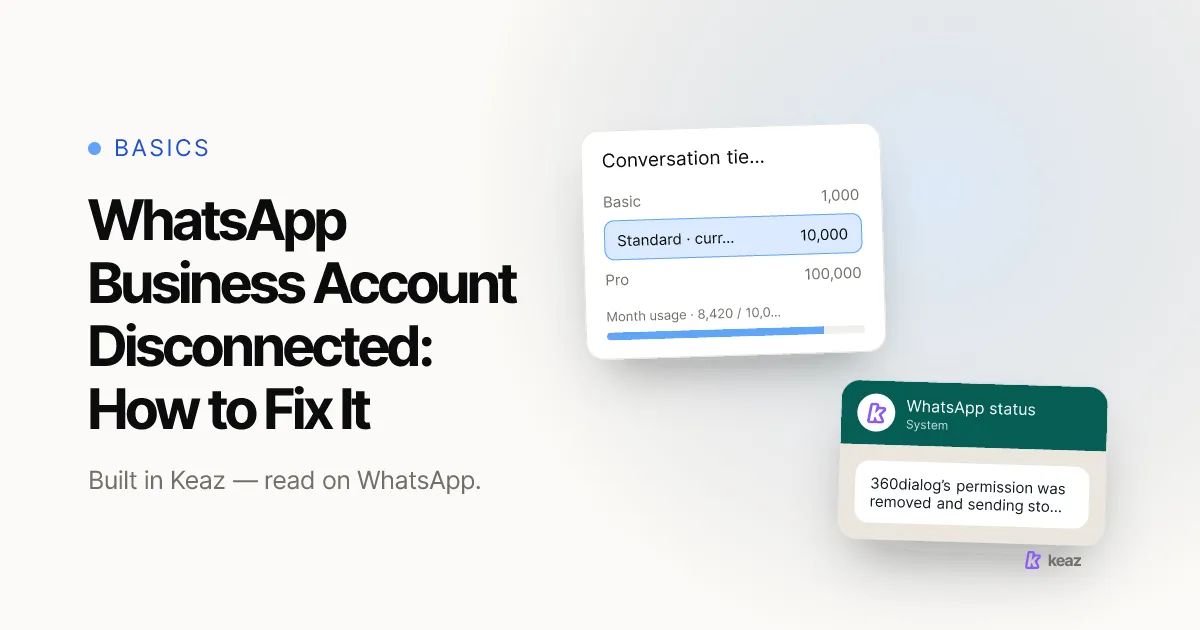
If your WhatsApp messages stopped going out and your flows are throwing errors, your WhatsApp Business Account is most likely disconnected rather than banned — and the cause sits in the partner list of your Meta Business Portfolio. Keaz sends through 360dialog, our WhatsApp Business Solution Provider, and 360dialog can only send because your portfolio grants it permission to. Remove that partner row and the permission goes with it: sending stops the same second, nothing is blocked or banned, and nothing tells you what happened.
- Three systems, one chain. Keaz, 360dialog and your Meta Business Portfolio. Break the middle link and nothing sends.
- Four clicks to break it. Meta's own removal path is four steps on a settings screen, and not one of them mentions WhatsApp.
- Zero warnings. No bounce, no email, no banner. Most shops find out after a flow has been erroring for days.
What happens when your WhatsApp Business Account is disconnected?
Your WhatsApp Business Account belongs to you, not to Keaz and not to 360dialog. What a provider holds is permission, granted from your business portfolio and revocable from the same screen.
Meta's platform documentation describes the model plainly: a partner's app is authorised against a client's assets through permissions the client grants, and the two that decide whether anything sends are whatsapp_business_management for templates and account settings and whatsapp_business_messaging for sending and receiving. See Meta's partner documentation for the WhatsApp Business Platform (Meta for Developers, retrieved 14 September 2026).
Take the partner off the list and both permissions leave with it. From that moment every send is an API call against an account the caller is no longer allowed to touch. Keaz keeps trying, the calls keep failing, and your flows keep firing into the error rather than into a customer's phone.
The chain you built when you first connected your WhatsApp account runs through all three systems in order. One removed row breaks the whole thing, and it breaks it silently.
How do you tell this apart from a blocked account?
These two failures look identical from the outside and need opposite fixes, so it is worth separating them before you touch anything.
- A removed partner. Nothing sends at all, test messages included. Meta shows no policy notice, your account standing is unchanged, and your templates are still approved. This is a permissions problem.
- A restricted or blocked account. Meta has taken an action and says so. There is a notice in Business Support Home, and sending is usually limited rather than dead.
The quick test is whether Meta told you anything. Enforcement comes with a message; a withdrawn permission does not. If you do have a notice, this is the wrong article and you want what a restricted WhatsApp account actually means instead.
How do you check your partner list?
Four steps, and you can do them yourself in under a minute.
- Open Meta Business Suite and switch to the business portfolio that owns your WhatsApp Business Account.
- Go to Settings, then Partners in the left-hand menu. If you cannot see Partners at all, you do not have full control of the portfolio — find out who does before going further.
- Look for your solution provider in the list. If it is not there, you have your answer and you can stop looking.
- While you are on that screen, check who else holds full control. A portfolio with exactly one administrator is a single point of failure for more than this.
Meta's help article on removing partners from your business portfolio (Meta Business Help Center, retrieved 14 September 2026) describes the same path in the other direction, which is also the honest explanation for why this keeps happening: it is four clicks from a screen most shops open once a year.
How do you get sending back?
Reconnecting is not a self-service fix, and attempting it alone is the most common way to turn a short outage into a long one.
- Tell your provider first. Reconnection needs something from both sides, and your provider can see which parts are missing. Starting before they know costs you the time they would have saved.
- Switch your flows off while the connection is down. A flow firing into a dead connection produces errors, not sends. Flow activation covers turning them off and back on.
- Expect one of two paths. Either the partner is re-added with the portfolio ID your provider gives you, or the connection flow is run again from your dashboard. Which one applies depends on what else came off the list. Do not start a fresh provider signup on your own — a second provider account leaves your connection on the wrong one, which the guide to connecting your WhatsApp account warns about explicitly.
- Send one test message before re-enabling anything. A delivered test is the only proof the permission is genuinely back. A settings screen that looks right is not.
Why is this so easy to do by accident?
Because every signal on that screen points away from what the row actually does.
- The row does not say WhatsApp. Partners are listed by business name. Nothing next to the name explains that removing it stops your messaging.
- It looks like housekeeping. Clearing out an agency you stopped working with is good practice. The row that sends your order confirmations sits in the same list as the one that ran an ad campaign two years ago.
- The person tidying is rarely the person sending. Business portfolios are usually administered by whoever first set up ads, not by whoever runs WhatsApp today.
- The confirmation dialog is generic. Nothing asks whether this partner happens to be your messaging provider, because Meta has no way of knowing which one matters to you.
Three of those four are organisational rather than technical, which is why the fix that lasts is a line in your own documentation rather than a setting somewhere.
How do you notice before your customers do?
The gap between the outage starting and someone noticing is the part that costs money, and it is the part you can shorten cheaply.
- Watch the error state, not the send count. A severed connection shows up as errors first. A send count that simply stops looks the same as a quiet week — reading the trigger history when a flow does not fire is the faster diagnostic.
- Put a name on the business portfolio. Someone has to own that screen who knows what the partner row does.
- Keep at least two people with full control. A portfolio whose single administrator has left the company is a worse version of this same outage.
- Test after anyone touches Meta settings. One message is a cheap regression test.
- Write the provider's name down. Next to the words do not remove, somewhere your team will actually find it.
It is worth knowing how much of your marketing depends on that one permission. Every Keaz flow is triggered by a real event in your store, so a severed connection stops the whole event-driven side at once rather than degrading gracefully — the flows and growth tools page is a fair inventory of what goes quiet.
Common mistakes
- Assuming a dead channel means a ban. Enforcement arrives with a notice. Silence points at permissions.
- Re-running the provider signup alone. A second provider account is a harder problem than the one you started with.
- Leaving flows active during the outage. They do not queue and retry later. They error.
- Treating the partner list as an ads setting. It is also your messaging setting, and nothing on the screen says so.
- Fixing the connection and forgetting the cause. If nobody establishes who removed the row, it comes off again.
- Choosing a provider without asking how they reconnect you. That belongs on the shortlist alongside integration depth and exit terms — how to choose a WhatsApp Business Solution Provider covers the rest of the questions.
A removed partner is the least dramatic way to lose your WhatsApp channel and one of the easiest to cause. Nothing is banned, nothing is broken, and nothing tells you: your WhatsApp Business Account is disconnected because a permission was withdrawn from a settings screen that never mentions WhatsApp. Check the partner list before you go hunting for an enforcement action that was never there. The technical repair takes minutes; deciding who owns that screen is what stops it happening a second time.
Before your next send, it is worth knowing what the channel is actually worth to you — calculate your WhatsApp revenue forecast.
Frequently asked questions
Does removing a partner delete my WhatsApp Business Account?
Why did nobody get an error message?
How long does reconnecting take?
Can I stop someone removing the partner again?
My sending stopped but the partner is still listed. What now?

Nils Spölgen
Founder at Keaz. Serial founder in chat marketing — built a local agency into Keaz, the WhatsApp marketing platform for Shopify. Bootstrapped the MVP, raised funding, and scaled to 200+ merchants in DACH. Writes about flows, opt-in & GDPR, Klaviyo, and realistic revenue benchmarks — prefers conservative math over impressive claims. View profile