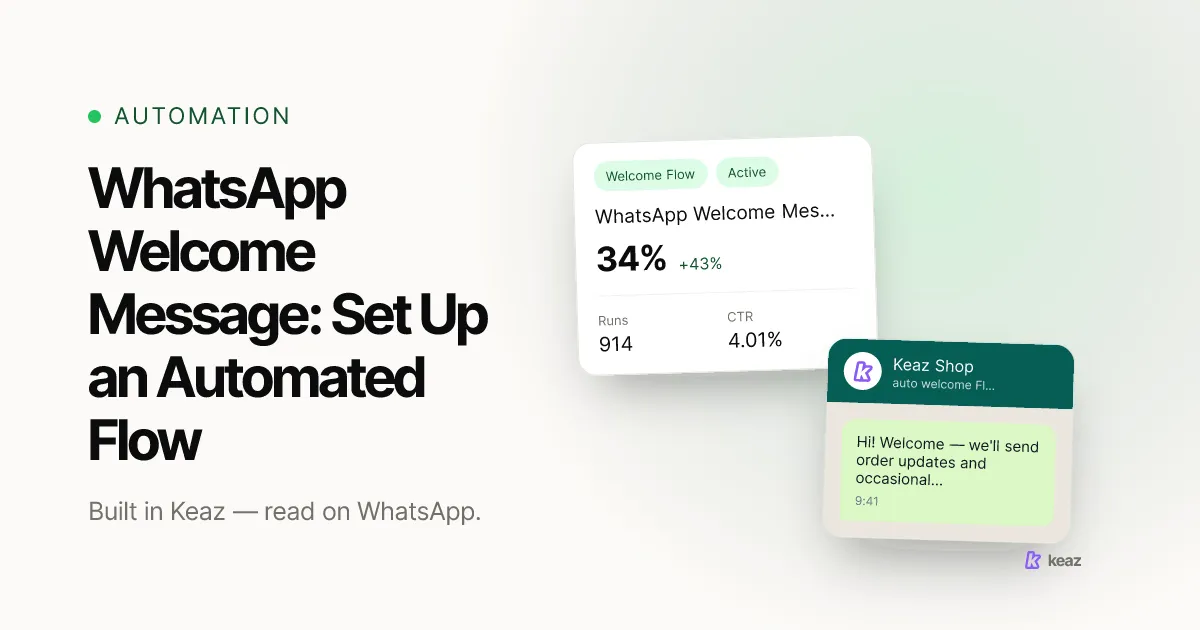
A WhatsApp welcome message is the first automated message a contact receives after they opt in or place their first order. In Keaz it is not a setting you switch on but a Flow: you choose the trigger, write one or two messages, set the minimum opt-in level, and it runs on its own from then on. Building it takes about 15 minutes, needs no code, and uses the Shopify data you already have.
The short version:
- About 34% of a typical Keaz shop's audience is reachable on WhatsApp and nowhere else — for them the welcome message is the only greeting they will ever see.
- Phone capture moves from 22% to 65–70% once the checkout field is actively encouraged, and that number decides how many people the welcome ever reaches.
- Customer Contact Coverage usually starts at 35–55% and reaches 85%+ in about 60 days once the collection points are live.
What is a WhatsApp welcome message — and what is it not?
It is the first message that goes out automatically when someone new enters your list, and its job is narrow: greet the person, say what you will send and how often, and offer one next step. Nothing else.
Two things it is often confused with, and neither is the same:
- The Conversation Starter. In Keaz that is the template wrapped around a chat you reopen after 24 hours of silence. It reacts to something you do, not to a new contact arriving.
- A newsletter. A Flow reacts to an event and runs continuously for individual contacts. A newsletter is written by you and goes out once to a whole segment.
The distinction matters because the welcome message is the only message in your programme that every single subscriber sees. Everything after it — cart recovery, reorder reminders, review requests — reaches a subset. This one reaches all of them, which is why it is worth more care than its length suggests.
Which trigger starts a welcome message in Keaz?
Every Flow begins with a trigger in its Starting point block, and three of the available triggers are the ones that make sense for a welcome.
- Chat-in — the contact writes to you first, through a QR code or a link that prefills the message. Every Chat-in Flow gets its own QR code and URL in the Flow detail view, so the entry point tells you which placement brought the contact in. See Flow trigger: Chat-in for the mechanics.
- Contact Purchase — a Shopify event. The Flow starts when a contact completes an order in your connected shop. If the order carried no phone number, Keaz has nothing to match it to and the Flow does not start for that order — the detail that quietly costs most shops their first welcome. Flow trigger: Contact Purchase covers it.
- Smart Activation — Keaz decides the sending moment per contact in order to keep spam reports low. Use it to re-permission contacts you have not spoken to in over twelve months, not to greet new ones.
Setting one up, start to finish:
- Open Flows and create a new Flow.
- Click the Starting point block.
- Select the trigger event — Chat-in or Contact Purchase.
- Set the minimum opt-in level, so only contacts with sufficient consent enter. Opt-in levels explains what each level allows; there is no separate subscriber list in Keaz, the level on the contact is the subscription.
- Add a Messages block and write the welcome. Use the dynamic variables for the first name.
- Add a Delay block only if you want a second message later.
- Give the Flow its own discount code so the revenue it produces is attributable to it.
- Save. For a Chat-in Flow, collect the QR code and URL from the Flow detail view.
The flow builder and the triggers behind it are the same for every Flow, so once you have built the welcome, cart recovery and review requests are the same handful of clicks.
What should the first message actually say?
The welcome message earns the right to send the second one. Four elements, in this order, do that reliably: name your shop, say why this person is hearing from you, say what comes next and how often, and give exactly one action.
Three openers that follow that shape:
- After a QR-code opt-in: "Hi {{First Name}}, you are in — thanks. This is Kaufmann & Co on WhatsApp. Expect about two messages a month: new arrivals and the occasional early access. Reply STOP any time. Want the current arrivals first?"
- After a first order: "Hi {{First Name}}, your order is on its way. You can reply to this chat any time if something is unclear — a person reads it. We will send you a note when it ships, and roughly twice a month after that."
- After a phone capture at checkout: "Thanks {{First Name}}. We will use this number for order updates, and about twice a month for new arrivals. If you only want the order updates, reply UPDATES and we will keep it to that."
Two rules of thumb worth more than any template. Keep it to one screen — a welcome that needs scrolling reads like a mailing, and mailings get muted. And make the frequency promise concrete: "about two messages a month" is the sentence people actually judge you by weeks later when they decide whether to stay subscribed. A vague promise is the most common reason a healthy list starts leaking.
How do you get enough contacts into the welcome flow?
The Flow is the easy half. Coverage is the half that decides whether it matters, because a perfect welcome message reaching a fifth of your customers is worth less than a plain one reaching most of them.
The collection points that move the number:
- The phone field at Shopify checkout, actively encouraged rather than merely present: capture moves from 22% to 65–70%.
- The after-checkout widget, for the orders where the field was skipped.
- A chat widget in the storefront, for people who are not buying yet.
- QR codes on packaging, print and in-store, each pointing at its own Chat-in Flow.
- Smart Activation for contacts older than twelve months, at most twice a year.
Together these typically lift Customer Contact Coverage — the share of your last-twelve-months Shopify customers you can reach on WhatsApp at all — from 35–55% to 85%+ in about 60 days. Our full guide to collecting opt-in the GDPR-compliant way walks through each collection point in detail.
Why bother, when you already send email? Because the audiences barely overlap. Across Keaz shops the split runs 24% email only, 38% both, 34% WhatsApp only, 3% neither — roughly a third of your audience is reachable on WhatsApp and nowhere else. WhatsApp read rates sit above 90% against email open rates of 30–40%; that is a published-benchmark band rather than a guarantee, and how we calculate the forecast shows how we use it conservatively. WhatsApp complements email here. It does not replace it.
Once the welcome is running, the next Flow to build is the one that earns most: cart recovery on WhatsApp. For the wider DACH context on where online demand is moving, the bevh publishes its annual study "Interaktiver Handel in Deutschland" (bevh, January 2025).
Common mistakes
- Sending before consent is documented. The Flow will happily run for a contact who never agreed to marketing. Set the minimum opt-in level in the Starting point and treat that as the gate.
- Using the Conversation Starter as a welcome. It only fires when you reopen a chat that went quiet. It will never greet a new contact.
- Turning it on before coverage exists. A welcome Flow on a list with 22% phone coverage greets one customer in five. Fix the checkout field first.
- Writing four paragraphs. Length in a chat reads as effort demanded, not effort given.
- Promising nothing. If you never say how often you will write, every later message feels like one too many.
- One message for every entry point. Someone who scanned a QR code on a package and someone who just paid you are in different moments. Two Flows, two openings.
- No discount code on the Flow. Without its own code the revenue the welcome generates cannot be attributed to it, and you will end up arguing about whether it works instead of measuring it.
- A Delay block where none is needed. A welcome that arrives four hours after the opt-in has lost the context it was answering.
A welcome message is the cheapest Flow you will ever build and the only one every subscriber sees. Pick the trigger, keep the message to one screen, name a frequency you can keep — then spend your remaining effort on coverage, because that is what decides how much the Flow is worth.
Want to see what WhatsApp would add on your own numbers before building anything? Calculate your forecast — it runs on your Shopify data and takes a couple of minutes.
This article is a summary rather than legal advice; have your own counsel review how you collect and document consent.
Frequently asked questions
Does a welcome message need an opt-in?
Can one Flow serve both new subscribers and first-time buyers?
How long should a welcome Flow be?
Can I measure what the welcome earns?
What if the customer never gave a phone number?
Nils Spölgen
Founder at Keaz. Serial founder in chat marketing — built a local agency into Keaz, the WhatsApp marketing platform for Shopify. Bootstrapped the MVP, raised funding, and scaled to 200+ merchants in DACH. Writes about flows, opt-in & GDPR, Klaviyo, and realistic revenue benchmarks — prefers conservative math over impressive claims. View profile