Since 1 October 2026, Meta charges for WhatsApp service messages, and for utility templates you send in reply to a customer inside the open 24-hour window. Both were free until then — service messages since 1 November 2024, utility-in-window since 1 July 2025. If your Shopify store answers people on WhatsApp, the replies your team types by hand are no longer free.
The short version:
- 2 free categories ended on 1 October 2026: all service messages, and utility templates sent in response to a user.
- 3 charges became 5 in Meta's own worked example — the same one-hour conversation, priced under the rules now in force.
- 1,000 free service messages per business phone number per month. Past that Meta charges — and a payment method on file is what keeps messages beyond the free tier being delivered at all.
What exactly became chargeable on 1 October 2026?
Two things, and they were two separate changes landing on the same date. Meta announced both in its pricing updates for Meta Business Agent, service and utility messages (Meta for Developers, updated 28 September 2026), and the main Pricing on the WhatsApp Business Platform document now records them as done: it opens by stating that it reflects pricing updates effective as of 1 October 2026 (updated 30 September 2026). Both retrieved 2 October 2026. The announcement page is still written in the future tense, so where the two differ, the main pricing document is the one describing today.
- Service messages. Any non-template message that is not powered by Meta Business Agent — a reply typed by someone on your team, or one produced by a third-party AI. These were not charged between 1 November 2024 and 30 September 2026. Meta now charges per delivered message, consistent with how it charges for templates.
- Utility templates sent in response to a user. That means a utility template delivered inside an open 24-hour customer service window. These were not charged between 1 July 2025 and 30 September 2026. They are now charged per message, and their pricing type in Meta's delivery webhook changed from free_customer_service to regular.
Nothing changed about when you may send. Non-template messages still only go out inside an open window, which opens and resets with every message a customer sends you. What changed is that the window stopped being free. The mechanics of the window are unchanged, and they sit alongside Meta's dated rate card on our WhatsApp facts reference.
How much do WhatsApp service messages cost?
Meta stated the rule rather than making you look it up category by category: by market, rates for service messages are the same as the rates for utility and authentication messages. The rates that took effect on 1 October were published on 1 September 2026, in line with Meta's pricing calendar, which allows rate changes only at the start of a quarter.
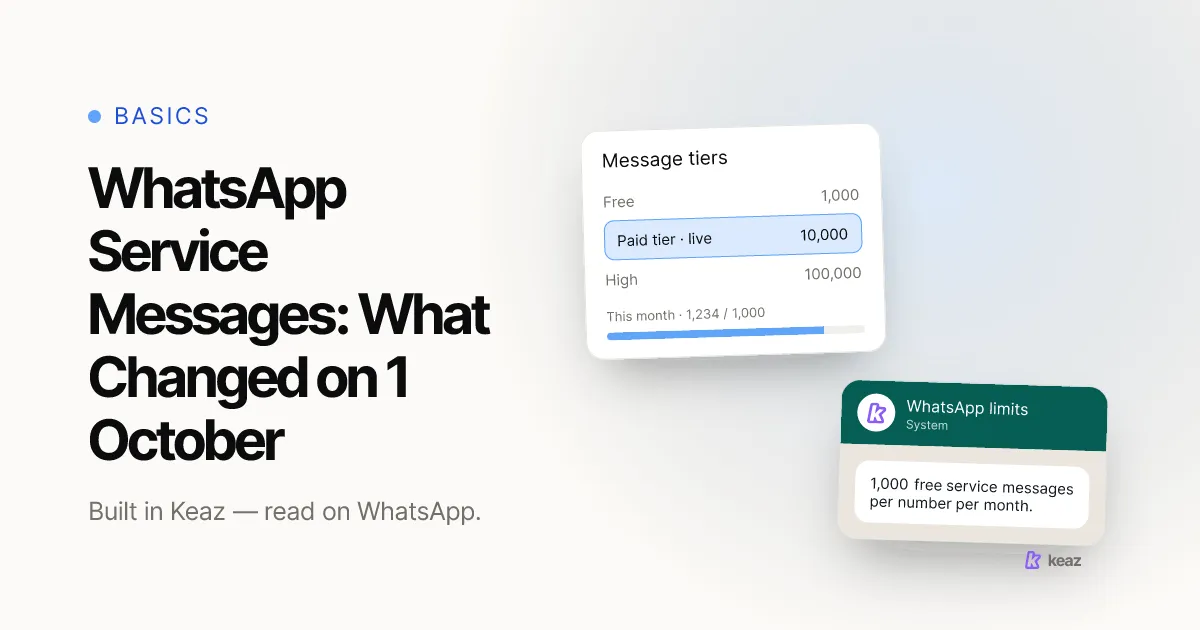
Published alongside those rates, and easy to miss: a free monthly tier. Every business phone number receives 1,000 free service messages per month, and Meta charges only from the 1,001st service message delivered. The allowance resets each month and unused messages do not roll over. For a store handling a few hundred conversations a month that covers the entire support load; for one running thousands, it takes the first slice off the bill and nothing more. Either way, work out your monthly reply volume per number before you budget anything — that number decides whether this change costs you anything at all.
One asymmetry is worth planning around. Beyond that free tier Meta offers no volume tiers for service messages, while volume tiers continue for utility and authentication. High reply volume therefore does not earn a discount the way high template volume does. A support-heavy month costs proportionally more than a campaign-heavy month of the same message count.
Two groups are outside this. Meta's separate AI Providers pricing policy governs providers of general-purpose AI assistants instead, and eligible government and non-profit organisations keep free service messages beyond the monthly tier through 31 December 2027. Neither describes an ordinary Shopify store automating its own support.
Because service tracks utility and authentication, those two rates are the ones to budget from. Germany is its own rate market on Meta's card; Austria and Switzerland sit under Rest of Western Europe. Germany's utility and authentication rates were not among the 40 rates Meta changed on 1 October, so a German store's service rate matches the utility rate it was already paying. The current per-market figures, each carrying the date we retrieved it, are in the dated table on the Keaz WhatsApp facts page. Treat any figure older than the last quarter boundary as a number to re-check, not a number to quote.
What does this do to one real conversation?
Meta walks through an example close to what a Shopify store actually runs: a cart-abandonment reminder, a couple of questions, a handoff to a person, an order confirmation — all inside one hour.
- The store sends a cart-abandonment reminder as a marketing template. Charged before 1 October, charged now.
- The customer asks whether the item comes in a small. That message opens the 24-hour customer service window.
- Two automated replies answer product questions. As Meta Business Agent messages, these have been charged per token since 1 August 2026.
- A person on the team takes over and sorts out an expired card. Free before 1 October. One service charge now.
- An order confirmation goes out as a utility template inside the same open window. Free before 1 October. One utility charge now.
3 charges in September, 5 charges now, for an identical conversation. One rule limits the damage: only one charge applies per message. A message has exactly one category, and a non-template message carrying promotional content does not additionally attract a marketing charge on top of its service charge.
If you are still working out which parts of WhatsApp cost money at all, our guide to whether WhatsApp Business is free separates the free app from the paid platform.
What is a Meta Business Agent message?
It is a message category Meta added on 1 July 2026. Since then, a non-template message is one of two things: a Meta Business Agent message, powered by Meta's own agent platform, or a service message, powered by anything else — a person, or a third-party AI tool. Every non-template message that is not Meta Business Agent is a service message, which is why the 1 October change reached further than a support inbox.
Meta Business Agent messages have been charged since 1 August 2026, and they are metered differently: per token, at one global rate of $2.00 USD per 1 million tokens. Meta states a single message typically consumes 20,000–25,000 tokens, which works out to roughly 4–5 US cents, and that cost scales with complexity — a short answer costs less than multi-turn problem-solving. Note that a business using a third-party AI instead pays that provider separately for AI usage on top of Meta's message charge.
The two categories also behave differently in the free entry point window — the window that opens when someone reaches you from a Click-to-WhatsApp ad and you reply inside 24 hours, and which may stay open for up to 7 days. Marketing, utility, authentication and service messages sent inside it remain free for delivery. Meta Business Agent messages do not: the token charge still applies there.
How should this change the way you design flows and replies?
Free replies inside the window were, in effect, a subsidy on conversational support. That subsidy ended on 1 October: the conversation itself is now metered, which turns a few habits into cost decisions.
- Answer completely, not repeatedly. Three short replies now cost three times what one clear reply costs. It is the cheapest change to make and the easiest to skip.
- Treat utility-in-window as a normal template. An order confirmation sent as a reply costs the same as one sent cold, so a flow that fires a confirmation into an open conversation no longer rides for free.
- Lean on free entry points. The free entry point window — up to 7 days from your reply — is unchanged for delivery, which raises the relative value of Click-to-WhatsApp Ads and Facebook call-to-action buttons as ways into a conversation.
- Know where the window stands before you type. Keaz shows the remaining time as a live countdown in the composer — see the 24h reply window in Keaz.
None of this argues for replying less. A support reply that prevents a return or rescues a payment was worth more than nothing before, and is still worth far more than a fraction of a cent. It argues for replying deliberately. Our guide to WhatsApp customer support for Shopify stores covers the operating side, and the Keaz template and flow library shows which replies are worth turning into an automation.
Common mistakes
Six that cost money or credibility now that the date has passed.
- Treating this as a support-team problem. Utility templates that reply to a customer inside the window are affected too, so any flow confirming an order or a shipment in an open conversation changed price on the same day.
- Reading "no payment method" as "no charges". Meta's current pricing document is specific: without a payment method on file it still delivers service messages inside the free tier of 1,000 per business phone number per month, and stops delivering them once that tier is used. It is a delivery consequence, not a billing one. If a chat then refuses to send, what a locked conversation looks like in Keaz is worth knowing.
- Confusing this with conversation pricing. Conversation-based pricing was replaced by per-message pricing on 1 July 2025. That is a separate, older change. 1 October 2026 changed which categories are billed, not how they are counted.
- Waiting for volume tiers to soften it. Meta says there are none for service messages, and says so in the same document that announced the charge: volume tiers continue for utility and authentication only.
- Budgeting from the marketing rate. Service tracks utility and authentication, which are the lower rates on Meta's card in every European market it lists. Using the marketing rate as a proxy overstates the impact and gets the decision wrong in the other direction.
- Quoting a rate from memory. Meta may change rates at the start of any quarter, with one, three or six months' notice depending on the type of change — and it changed 40 of them on 1 October. Re-check the source before a figure goes into a board deck, which is why every number on our facts page carries the date it was retrieved.
The change was narrow and the date has passed. Two categories became chargeable on 1 October 2026: WhatsApp service messages, and utility templates sent in reply inside an open window. Meta's own example shows the same conversation going from 3 charges to 5, and the first 1,000 service messages per business phone number stay free each month. If you have not put a payment method on file, do that first — without one Meta delivers service messages inside the free tier and nothing past it. Everything after that is a design question: reply completely rather than repeatedly, treat a reply in an open window as a message you are paying for, and use free entry points where the traffic allows.
Want the number for your own store rather than Meta's example? Open the Keaz Forecast and see what WhatsApp is worth against your Shopify revenue.
Frequently asked questions
Are WhatsApp service messages still free after 1 October 2026?
What happens if there is no payment method on file?
Do utility templates inside the 24-hour window still go out free?
Does the free entry point window still work?
Nils Spölgen
Founder at Keaz. Serial founder in chat marketing — built a local agency into Keaz, the WhatsApp marketing platform for Shopify. Bootstrapped the MVP, raised funding, and scaled to 200+ merchants in DACH. Writes about flows, opt-in & GDPR, Klaviyo, and realistic revenue benchmarks — prefers conservative math over impressive claims. View profile