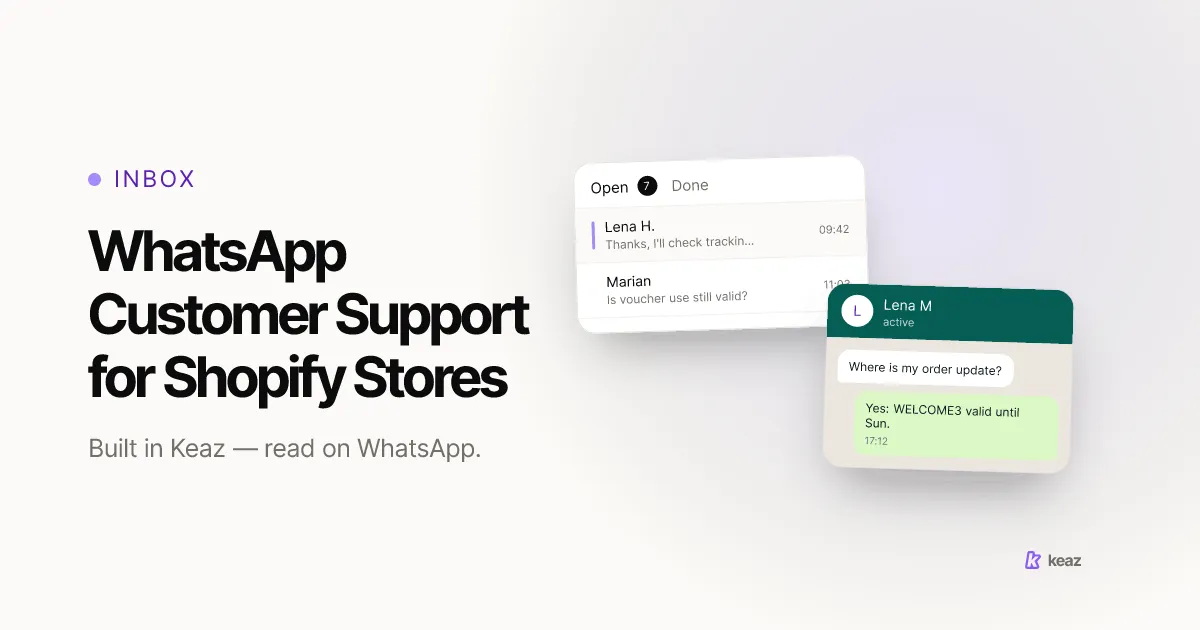
WhatsApp beats email for support in one narrow case, and it is a common one: the customer asks about an order they have already placed, and the answer fits into two sentences. It is the wrong channel when a case needs a specialist, a written record, or a queue that still holds up on a busy Monday. For a Shopify store in DACH it is at least where the customers already are — 83% of 16- to 74-year-olds in Germany used a messenger service in the first quarter of 2025 (Federal Statistical Office, 2025), and WhatsApp is by a wide margin the most used of them (ARD/ZDF-Onlinestudie).
Short version:
- 83% of people aged 16 to 74 in Germany used messenger services in Q1 2025. Email open rates, for comparison, sit in an 18–25% band.
- Most Shopify stores can reach 35–55% of their last-12-months customers on WhatsApp when they start. Support can never be better than that number.
- One shared number, two tabs — Open and Done. For a team of one to ten people the change is queue discipline, not another channel to staff.
When does WhatsApp beat email for support?
Use WhatsApp where speed and context matter more than completeness. That is most of what a store actually gets asked.
- Where is my order, and when will it arrive?
- Does this run small — should I size up?
- I want to exchange this, what do I do?
- Is this back in stock yet?
These questions have short, factual answers, and the customer usually reads them within minutes. In our own benchmark band, business messages on WhatsApp see open rates above 90% and click-through starting around 20%, against 18–25% open rates and under 3% click-through for email. Those are labelled bands rather than promises — how we calculate our numbers explains where they come from.
The channel also has an advantage email cannot copy: the reply lands in the same thread as the order confirmation the customer already received. Because the flows and templates we ship are triggered by Shopify events, the support answer sits in a conversation that already contains the order, the shipping notice and the customer's own questions.
When is WhatsApp the wrong support channel?
Being honest about this saves you from a channel nobody trusts. WhatsApp complements email; it does not replace it.
- Cases that run over several days and need attachments, references and a readable trail.
- Payment or warranty disputes, where both sides want a formal written record.
- Anything that has to reach a named specialist rather than whoever is on shift.
- Any queue nobody owns. An unanswered WhatsApp message reads as rudeness in a way an unanswered email does not.
There is also a hard arithmetic limit. A store that can reach 40% of its customers on WhatsApp cannot make WhatsApp the only door into support — the other 60% still need email, and they will notice if it has quietly been abandoned. Coverage first, channel second.
Where do support and marketing meet — and where must they not?
They meet at the moment the customer starts the conversation. A Chat-in flow gives you a QR code and a link; the customer taps it, WhatsApp opens with a message already filled in, they send it, and the flow you built runs. Each Chat-in flow gets its own code and URL, so a card in the parcel, a sticker in the shop and a button on the product page stay measurable separately.
That is genuinely useful, and it is where discipline is required. A customer writing in about a delivery has asked you a question — they have not agreed to receive campaigns. Consent for marketing stays a separate, explicit, documented step, and the safe default is to ask for it in its own message rather than reading it into a support thread. How to collect WhatsApp opt-ins properly covers the principles.
Common mistakes
Five failure patterns, in the order we see them:
- Treating WhatsApp as a broadcast channel with a reply box. If the only reason the inbox exists is to catch replies to campaigns, it will be answered late, and the channel will teach customers not to write.
- Opening the channel without a coverage plan. At 35–55% reachable customers, WhatsApp is a second door, not the front one. Raise coverage first.
- No handover between automation and a human. The most common concrete error: a flow has already answered, the agent answers again differently. The "You, Automated" label exists precisely to stop this — read the thread before typing.
- Nobody owns the Open tab. One named person per shift, or the queue silently becomes everyone's second priority.
- Turning a support conversation into a marketing list. It is the fastest way to lose both the consent and the customer.
Run WhatsApp for support when the questions are short and the answers are factual, keep email for everything that needs a record, and put coverage before either. The part that decides whether it works is not the channel — it is whether one shared queue has an owner and whether the person replying can see the order without asking.
Before you staff it, get the number: calculate your forecast and see what WhatsApp is worth per month for your store's own Shopify data.
This is a summary rather than legal advice — have your own counsel review how you collect and document consent.
Frequently asked questions
Do we need a separate number for support and marketing?
Can two people answer at the same time?
Does WhatsApp replace our email helpdesk?
What do we do about voice messages?
How do we know whether it is working?

Nils Spölgen
Founder at Keaz. Serial founder in chat marketing — built a local agency into Keaz, the WhatsApp marketing platform for Shopify. Bootstrapped the MVP, raised funding, and scaled to 200+ merchants in DACH. Writes about flows, opt-in & GDPR, Klaviyo, and realistic revenue benchmarks — prefers conservative math over impressive claims. View profile