WhatsApp customer segmentation means splitting your contact list into groups you message differently — and on Shopify the useful split is almost always built from order data you already have. Start with five segments, not fifteen: recent buyers, lapsed buyers, high-value customers, contacts who never purchased, and contacts who never engage on the channel. Each answers a different question, and each changes what you send.
You do not need a data team for this. Segments are built from condition groups over your shop data and your WhatsApp behaviour, and a live preview tells you how many contacts a segment covers before you save it.
In short
- Start with five segments, not fifteen — recent, lapsed, high-value, never-purchased, unengaged.
- Published research puts the revenue lift from personalisation at 10–15%, with company-specific results spanning 5–25% (McKinsey, 2021).
- Across Keaz stores, 34% of customers are reachable on WhatsApp only, against 24% on email only — segmentation decides which of them hears from you.
Why does segmentation matter more on WhatsApp than on email?
Because a badly targeted WhatsApp send costs you twice. You pay per template message, so half a list that was never going to convert is half a bill wasted. And you spend it in a thread the reader treats as personal, which is why irrelevant messages produce opt-outs faster here than in an inbox.
The upside is the same asymmetry in reverse. Across Keaz stores the audience splits 24% email only, 38% both channels, 34% WhatsApp only and 3% neither — so roughly a third of your customers are reachable here and nowhere else. WhatsApp complements email rather than replacing it, and segmentation is what stops the two channels sending the same thing twice. Our flows and growth tools run off the same audience layer.
On the value of getting it right, published third-party research is worth quoting as a band rather than a promise. McKinsey's Next in Personalization report puts the revenue lift from personalisation at 10–15% most often, with company-specific results spanning 5–25% depending on sector and ability to execute (McKinsey & Company, 2021, retrieved 2026-08-31). How we treat outside benchmark bands is set out in our methodology.
What can you actually segment on?
The condition list has two halves, and knowing which half you are reaching for is most of the skill. Shop data describes what someone bought:
- Country, phone country code, label
- Average order value, last purchase, order count, total revenue
- RFM group, predicted spend tier
- Clicked a button, and when they clicked it
WhatsApp data describes how someone behaves on the channel: whether they have interacted with you and when, whether a message could not be delivered, whether they received a flow, a newsletter, a keyword reply or any message and when, and their opt-in level.
If you already build segments in the Shopify admin this will feel familiar — Shopify's own segment editor combines filter names, operators and values in much the same way (Shopify Help Center, 2026, retrieved 2026-08-31). The difference is the second half of the list: how someone behaves in a WhatsApp thread is not something your shop knows.
The logic is worth reading off the screen before you trust it. Inside a single condition group every condition must be met — that is AND. Between condition groups at least one must be met — that is OR. Excluded groups work identically but subtract, which keeps a carve-out inside one segment instead of forcing you to maintain a second, inverted one. The full condition reference lives in our guide to the segment builder.
One condition is different in kind from the rest. Opt-in level does not describe a customer, it describes your permission to contact them — and no combination of the other conditions overrides it. Consent has to be explicit, documented and revocable; how to collect it that way is covered in collecting WhatsApp opt-ins the GDPR-compliant way.
Which five segments should you build first?
These five cover most of what a store does before it needs anything more granular. Build them in this order, because each one changes a different decision.
- Recent buyers — last purchase inside 30 to 60 days. This is your care and cross-sell audience: shipping follow-up, a review request, the product that pairs with what they bought. Do not discount to it. These people already bought at full price.
- Lapsed buyers — last purchase 120 days or more. One incentive, used sparingly, and rested afterwards. This is the segment most stores over-message, which is how a winback turns into an opt-out.
- High-value customers — total revenue or average order value above your own median. Early access and launches rather than discounts. If you want to score this properly instead of eyeballing a threshold, use the RFM group condition and read RFM analysis for Shopify.
- Never purchased — order count of zero, opted in. They gave you a number and then stalled. One first-order path, not the same campaign your buyers get.
- Unengaged on the channel — received a newsletter but never interacted, or messages that could not be delivered. Suppress or re-permission. Every send to this group is money spent on people who are not there, and it drags your channel quality down with it.
Notice that four of the five are defined by recency or value, not by anything clever. Once these exist, every campaign is a choice between them rather than a fresh audience build — and each one is reusable, because every WhatsApp newsletter send picks a segment as its recipient list.
How do you know a segment is worth sending to?
Check it before you save it, not after you send. The builder recalculates three numbers while you edit:
- Audience coverage — the share of all your contacts this segment currently matches.
- Average order value of the contacts in it.
- Average time since their last purchase.
Read the last two together and the segment tells you what it is. Large, with a low average order value and a long time since the last purchase, is a re-engagement audience — not the high-value one you may have thought you were building. That should change the message, not just the list. A small segment with a high average order value and recent purchases is worth a launch; the same size with the opposite numbers is worth a re-permission.
Segments stay editable at any time without affecting campaigns that have already gone out, so there is no cost to tightening one. If you want the euro figure attached to the coverage gap on your own store rather than a general argument, the forecast calculates it from your Shopify data.
Common mistakes
Five that come up repeatedly, in roughly the order they cost money.
- Sending to everyone because the list is a mess. The fix is to clean the labels, not to widen the send. If your labels date from trialling the product and no longer mean anything, start with how labels work and rebuild them deliberately.
- Confusing labels with segments. A label is manual and editorial — you assign it, so you decide what it means. A segment is derived from data and updates itself. Using labels where a segment belongs means maintaining by hand what the shop already knows.
- Building fifteen segments you never send to. Overlapping segments make reporting unreadable, because you can no longer tell which audience produced a result. Five you use beat fifteen you maintain.
- Forgetting that opt-in level is not a targeting condition. The conditions decide who matches. Opt-in decides who you may contact. A segment can be perfectly built and still contain people you must not message.
- Treating a big segment as a good segment. Coverage on its own says nothing about whether a send will pay. Check average order value and recency first.
One more, if you are arriving from email: an audience imported from Klaviyo is a starting point, not a finished segment. It was built for a channel with different costs and a different tolerance for frequency, and it usually needs tightening before its first WhatsApp send.
Segmentation on WhatsApp is less about clever rules than about deciding, group by group, what you want to happen next. Five segments built from recency and value will carry a store a long way, and the discipline that matters is checking coverage, average order value and recency before the send rather than reading them afterwards in a report.
If you want the euro figure attached to closing the coverage gap on your own store, run the forecast — it works from your Shopify data rather than an industry average.
This article touches consent rules in outline only. It is a summary rather than legal advice — have your own counsel review your opt-in setup.
Frequently asked questions
How many segments should a Shopify store start with?
What is the difference between a label and a segment?
Can I reuse the segments I already built in Klaviyo?
Does a segment decide whether I am allowed to message someone?
Can I change a segment after I have used it?
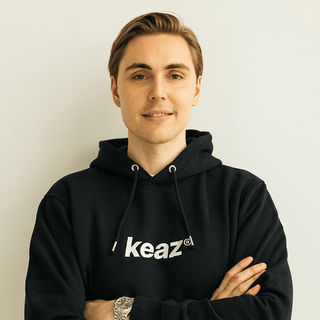
Nils Spölgen
Founder at Keaz. Serial founder in chat marketing — built a local agency into Keaz, the WhatsApp marketing platform for Shopify. Bootstrapped the MVP, raised funding, and scaled to 200+ merchants in DACH. Writes about flows, opt-in & GDPR, Klaviyo, and realistic revenue benchmarks — prefers conservative math over impressive claims. View profile