If you are comparing Superchat with other WhatsApp tools for your Shopify store, the question that decides it is not which product has the longer feature list. It is which of two different jobs you are hiring for. Superchat, Wati and Chatarmin sit in the multi-channel messaging category: one inbox, several channels. Keaz sits in a different one — a Shopify-native WhatsApp marketing tool that runs on your shop's own events and reports revenue per flow. Name the job first and the shortlist gets short.
In short
- Reach sets the ceiling. Most Shopify stores start with 35–55% of their last-12-months customers reachable on WhatsApp; with Keaz that moves past 85% in about 60 days.
- Attribution decides whether you can defend the channel. Every Keaz flow gets its own discount code, created in Shopify automatically, so revenue lands on a named flow instead of on "WhatsApp".
- One flow usually carries the programme: Cart Recovery converts at 18–30% and accounts for roughly 40% of WhatsApp revenue in a running setup.
Superchat or a Shopify-native tool: which job are you hiring for?
A multi-channel inbox and a Shopify-native marketing tool solve different problems, and stores usually have one of them badly and the other not at all.
A multi-channel inbox is the right category when your primary problem is inbound: messages arriving on WhatsApp, Instagram, email and the site widget, landing in different places, answered twice or not at all. What you are buying is one queue and a way to divide it between people. If that is your week, buy that.
A Shopify-native marketing tool is the right category when your primary problem is that WhatsApp is not earning anything yet. What you are buying is event-driven sending — a message that goes out because a checkout was abandoned or an order was placed — plus the list to send it to and the reporting to prove it worked. That is what Keaz is: see what the platform does.
Keaz has an inbox, with labels, filters and a visible reply-window clock, and it is enough for a small team — how small teams share one WhatsApp number goes through the setup. But it is a shared inbox for a Shopify store, not a general-purpose helpdesk for six channels. That is the honest boundary, and it is worth checking against your own week first.
Which six questions actually decide it?
Feature lists rot and every vendor writes their own. These six questions are answerable from a trial account in an afternoon, and they are the ones that still matter a year later.
- Does it read your shop, or only send to it? The useful test: can a message be triggered by an abandoned checkout or a completed purchase without you exporting anything? In Keaz those are flow triggers alongside chat-in and webhook triggers, so the sending side runs unattended.
- Can you see revenue per flow, not just per channel? A channel-level number tells you nothing you can act on. Keaz creates one discount code per flow in Shopify automatically and attributes redeemed revenue to that flow, with the same mechanism per newsletter. Ask any tool how it answers "what did Cart Recovery earn last month".
- How does it grow the list, or does it only message it? A tool that sends beautifully to 40% of your customers is worth less than a plain one that reaches 85%. Check for a phone field at checkout, a post-checkout capture widget and a way to re-permission dormant customers.
- Does it sit next to your email tool or fight it? On our own audience data, 24% of customers are reachable by email only, 38% by both, 34% on WhatsApp only and 3% on neither — so a third of the people you want are unreachable by email. Keaz connects to Klaviyo rather than replacing it; running Klaviyo and WhatsApp together covers how the two divide the work.
- Can you model the outcome before you commit? Any tool can show you a case study. Ask for a number computed on your shop: the Forecast runs on your own Shopify data, and the per-industry ranges show what the first 90 days look like in your vertical.
- Who operates it every Tuesday? Setup is a one-off; the weekly routine is not. Connecting Shopify to Keaz is a single click, no code and no developer, and after that the flows run themselves. If a tool needs someone to build campaigns by hand every week, that person is part of the price.
How do you know a WhatsApp tool is paying for itself?
The answer should be a number you did not have to argue about, and it comes from two scores and one attribution mechanism.
Customer Contact Coverage (CCC) is the share of your last-12-months Shopify customers you can reach on WhatsApp at all. Stores typically start between 35% and 55%. Getting past 85% takes about 60 days and is mostly plumbing, not persuasion.
Marketing Contact Coverage (MCC) is the share of your email subscribers who are also reachable on WhatsApp. It exists once Klaviyo is connected, and usually starts at 15–30% and settles at 50–70%. It tells you whether WhatsApp is adding audience or re-messaging the same people.
On top of those, the dashboard is deliberately blunt: the score, the money the gap costs you per month, and the three next moves ranked by euro impact. Revenue attributed to Keaz sits next to total shop revenue, and per flow and per newsletter underneath it — which is what turns "WhatsApp seems to be working" into a line you can defend.
For channel-level expectations, published benchmark bands put WhatsApp read rates above 90% against email open rates of 30–40%, with roughly 1.5× the conversion rate on a shared audience. Those are bands, not promises — how we calculate them is written up separately. WhatsApp complements email here; it does not replace it.
What does your reach on WhatsApp actually depend on?
Almost every disappointing WhatsApp programme is a coverage problem wearing a tooling costume. Four levers move it, and none of them is the message copy.
- The phone field at checkout. The largest single lever. Shopify lets you set the customer contact method to phone number or email, and documents that requiring both at once is not supported on standard plans (Shopify Help Center, retrieved August 2026) — so how you configure this decides what you can collect. Stores that encourage the phone number at checkout move from roughly 22% capture to 65–70%.
- The post-checkout widget. It appears only to buyers who did not leave a number in the order, and there is a Safe mode that restricts it to users with clear opt-in intent for stricter GDPR readings — see connecting Shopify to Keaz.
- The chat-in widget on the storefront. A QR code and a start-chat button, live in one click. It converts intent that would otherwise become an unanswered contact-form message.
- Smart Activation for dormant customers. For customers older than twelve months it asks for consent again, and it is capped at twice a year on purpose. Asking is slower than sending and it is the only version that survives.
All four rest on the same principle: consent has to be explicit, documented and revocable before you message anyone. The GDPR frames consent as freely given, specific, informed and unambiguous (Regulation (EU) 2016/679, 2016). A tool that helps you skip that step is not a shortcut, it is a liability.
Common mistakes
These are the ones that cost stores a quarter, roughly in order of how often we see them.
- Comparing feature lists before naming the job. Two products in different categories both list "WhatsApp" and "automation". The comparison means nothing until you have written down which problem you are paying to remove.
- Buying a shared inbox to fix a revenue problem. A tidier queue does not send an abandoned-checkout message. The reverse mistake is just as common.
- Judging the channel without per-flow attribution. "WhatsApp made €4,000" is not a decision input. Which flow made it, and what it cost to run, is.
- Migrating a contact list and treating consent as migrated too. The data moves; the permission does not follow. Re-check opt-in level before the first send.
- Assuming WhatsApp replaces email. About a third of the audience is reachable on WhatsApp and nowhere else — and about a quarter only by email. Cancelling the email tool throws away a quarter of your reach.
- Evaluating on a test send instead of on coverage. A test message always looks good. Run the coverage number first; it sets the ceiling on everything afterwards.
The Superchat comparison resolves faster than it looks, because it is not really about features. One category gives you a tidier inbox across many channels. The other gives you a WhatsApp channel that runs on Shopify events and reports what it earned, flow by flow. Write down which of those two your store lacks, and the decision is already made.
Before you shortlist anything, get the number that sets the ceiling: how much of your customer base is reachable on WhatsApp today, and what that is worth per month. Calculate your forecast — a few minutes, on your own Shopify data, no code.
This article is a summary rather than legal advice. Consent requirements differ by market and by how you collect them, so have your own counsel review your opt-in flow before you rely on it.
Sources: Shopify Help Center — editing the checkout form options (Shopify, retrieved August 2026) and Regulation (EU) 2016/679 (GDPR) (EUR-Lex, 2016). Product behaviour and coverage figures are from the Keaz help center and product documentation, retrieved August 2026.
Frequently asked questions
Is Keaz a Superchat alternative?
Can I run Keaz alongside Klaviyo, or do I have to choose?
Do I need a developer to switch?
What happens to my existing WhatsApp contacts if I move tools?
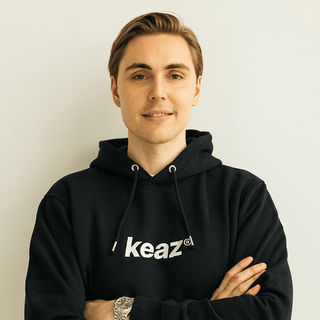
Nils Spölgen
Founder at Keaz. Serial founder in chat marketing — built a local agency into Keaz, the WhatsApp marketing platform for Shopify. Bootstrapped the MVP, raised funding, and scaled to 200+ merchants in DACH. Writes about flows, opt-in & GDPR, Klaviyo, and realistic revenue benchmarks — prefers conservative math over impressive claims. View profile