There is no "newsletter" button in WhatsApp. What people mean by a WhatsApp newsletter is three things stacked together: a list of people who agreed to hear from you, message templates you are allowed to send, and a tool that segments and reports. Get those three right and you are messaging an audience that reads within minutes. Get the first one wrong and you lose the channel.
- 34% of your customers are reachable on WhatsApp and nowhere else — that is the audience a newsletter here actually adds
- Segmented sends hold around 30% active rate; unsegmented blasts fall to 15–25% and start earning blocks
- Most shops reach 15–30% of their existing email list on WhatsApp at the start, and 50–70% after asking properly
What do you need before the first send?
Three prerequisites. Skipping any of them does not slow you down — it costs you the channel later.
- A consented list. Explicit, documented, revocable — and separate from the order. A phone number from your Shopify checkout is not permission to market: under Article 7 of the GDPR (Regulation (EU) 2016/679), consent has to be demonstrable and as easy to withdraw as it was to give. The details are in how to collect WhatsApp opt-ins the GDPR-compliant way.
- Message templates. Marketing messages go through an approval step before you can send them. Practical consequence: you cannot write a campaign the morning it goes out. Build the message templates you know you will need — restock, new arrival, early access — before you need them.
- A tool that segments and reports. Without segmentation you are sending one message to everyone, which is the fastest way to train people to block you. Without reporting you cannot tell a good send from a lucky one. In Keaz every send picks a segment and reports revenue, delivery and read rate back — see the newsletter overview in the help center.
Do you need the WhatsApp Business API for this? For anything past a few dozen contacts, yes — the consumer app has no segmentation and no reporting, so it cannot do points two and three.
How do you build the list without buying anything?
You already have the audience. What you do not have yet is permission to reach it on WhatsApp. Three sources, in the order they pay off:
New customers, as they arrive. The phone field at checkout is the single biggest lever — capture reaches 65–70% once the field is asked for clearly instead of left quietly optional. Where you change that is the checkout form options page in your Shopify admin (Shopify Help Center, 2026). Behind it: a post-purchase opt-in for the ones who skipped it, the order confirmation, a storefront pop-up, and the passive channels that cost nothing per month — page widget, QR codes on packaging, link in bio.
Your email list. A permanent WhatsApp opt-in link in the footer of every email you already send, plus one deliberate invitation to the whole list. Shops typically start able to reach 15–30% of their email subscribers on WhatsApp and get to 50–70%. This is where the volume is.
Your back catalogue. Customers who bought years ago and were never asked. You cannot start messaging them, but you can ask once — that is what Smart Activation does, for customers who ordered more than 12 months ago, throttled to two runs per year. A single run often unlocks more reachable contacts than the next 90 days of new orders combined.
Watch one number while you do this: the share of your last-12-months customers you can reach on WhatsApp. Most shops start between 35% and 55% and pass 85% within about 60 days. If it is not moving, whatever you added is not working.
What should you send, and how often?
The fastest way to ruin a WhatsApp list is to treat it like an email list. Email tolerates a weekly send that exists because it is Thursday. WhatsApp does not — it sits in the same thread as the reader's family.
The numbers make the case better than the principle does. Segmented, intent-driven sends hold an active rate around 30%. Unsegmented broadcasts drop to 15–25% and start collecting blocks. Same list, same product — the difference is whether the message had a reason to arrive. Which contacts get which message is what the segment builder decides.
So send on triggers, not on a calendar. What earns its place:
- Back in stock — the highest-intent message you will ever send, converting at 25–40%
- Re-order timing — hitting the point in the cycle where the product runs out, at 12–22%
- Genuinely new products, and early access before the public drop — the closest thing to a classic newsletter that works here
- One-off sends with a real reason — a launch, a closing collection, a date that matters
Rule of thumb: if you cannot say why this message arrives today rather than next week, do not send it. Frequency is not the lever — timing is.
None of this replaces your email programme. WhatsApp reaches the customers email loses and lifts conversion on the ones it already reaches — from 2.1% to 4.5% on a shared audience, roughly 1.5×. We break that split down in our comparison of WhatsApp and email marketing.
Common mistakes
Four failures account for most dead WhatsApp lists. All four are cheap to avoid and expensive to undo.
- Treating the checkout phone number as consent. It is a delivery detail, not a marketing permission. Messaging on that basis is the one mistake that can cost you the channel rather than just a campaign.
- Importing the email list. An email opt-in does not transfer. The list has to be asked again, which is exactly what the email footer link and the one-off invitation are for.
- Sending on a calendar. A weekly send with nothing behind it moves an active rate of around 30% down toward 15–25% and converts unsubscribes into blocks. A block is permanent in a way an unsubscribe is not.
- Writing the campaign the morning it ships. Templates go through approval first, so the send you planned for Friday needs its template built well before Friday.
The pattern behind all four: WhatsApp punishes the habits email forgives.
A WhatsApp newsletter is not a feature you switch on. It is a list you earned, templates you prepared, and the discipline to send when there is a reason. The shops that get this right are not the ones sending most often — they are the ones whose messages arrive at the moment the customer was already thinking about the product.
Start with the checkout phone field and one invitation to your email list. That is most of the distance.
Want to know what that reach is worth in your shop? Run the forecast — enter your vertical, revenue and customer count and see what each unused flow costs you per month. How we calculate it is documented in the forecast methodology.
Frequently asked questions
Is a WhatsApp newsletter allowed in Germany?
Can I import my email list?
How many subscribers do I need before it is worth it?
Will people unsubscribe?
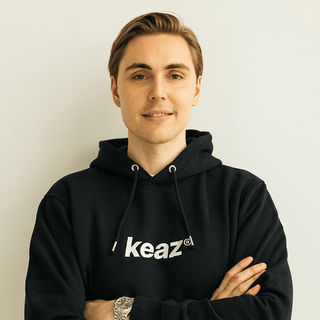
Nils Spölgen
Founder at Keaz. Serial founder in chat marketing — built a local agency into Keaz, the WhatsApp marketing platform for Shopify. Bootstrapped the MVP, raised funding, and scaled to 200+ merchants in DACH. Writes about flows, opt-in & GDPR, Klaviyo, and realistic revenue benchmarks — prefers conservative math over impressive claims. View profile