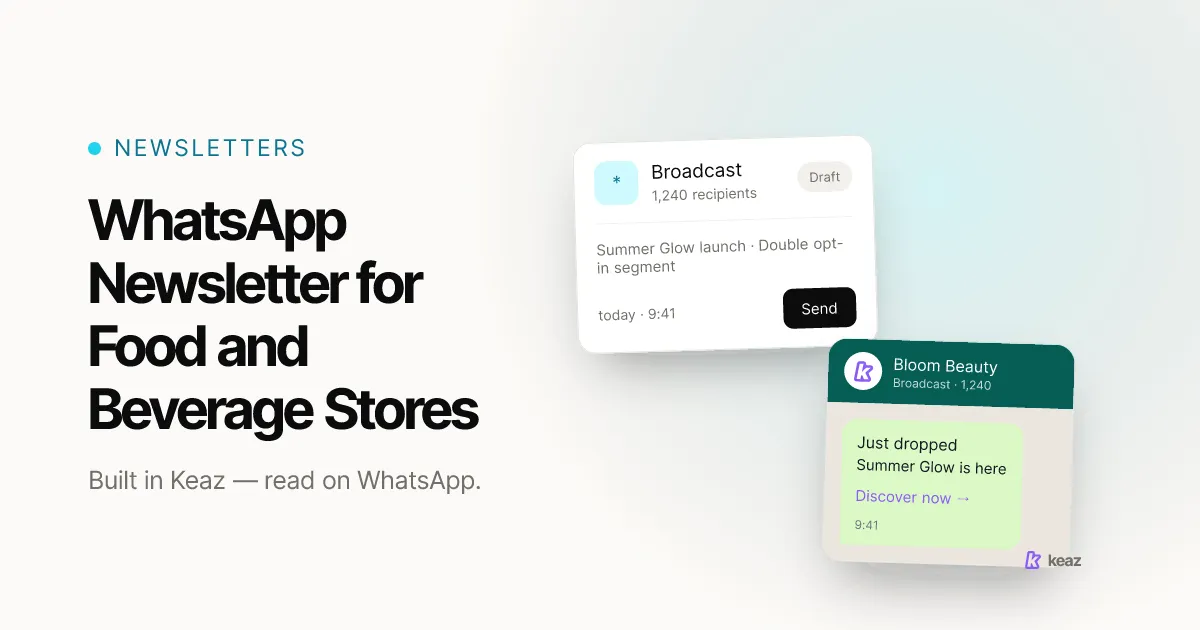
A WhatsApp newsletter for food and beverage stores works best when it follows the reorder cycle rather than a content calendar. Consumables get bought again on a rhythm — coffee roughly every three weeks, olive oil every two months, dog treats when the bag runs out. A message that arrives when the shelf is empty converts. The same message sent because Tuesday is newsletter day does not.
Short version:
- Keaz benchmark for Food & Beverage in the first 90 days: €38 average order value, 13% of welcome messages lead to a purchase, 20% cart recovery.
- Re-Order Reminder is the strongest flow in this vertical at 12–22% conversion — roughly three times what browse abandonment returns (4–8%).
- Around 34% of your customers are reachable on WhatsApp and on no other channel, and 38% on both WhatsApp and email — so this is an addition to your email list, not a replacement for it.
How often should you send to a food and beverage list?
Set cadence from the product's consumption cycle, not from a calendar. A coffee subscriber's cycle is two to four weeks; a specialty vinegar buyer's is closer to six months. Send at one frequency to both and you are early for one and late for the other.
A workable rule of thumb: one flow-driven message per customer per cycle, plus at most one broadcast a month on top. On a well-covered list that lands at roughly two to three messages a month per person — enough to stay useful, low enough that your unsubscribe rate stays where you want it.
The mechanics of building and sending a broadcast are covered in Newsletter: Overview in the help center.
How does the Re-Order Reminder work alongside a broadcast?
A flow and a broadcast answer different questions. The flow asks "is this customer due?" and picks its own moment for each person. The broadcast asks "is today worth telling everyone about?" and picks one moment for the whole list. Run both and you need a rule for the overlap.
The rule that works: exclude anyone who received a flow message in the last seven days from the broadcast. In practice that means building the broadcast on a segment rather than on the whole audience.
Segments are built in the Segment Builder, and the contact model underneath them is described in Audience: Overview.
What numbers should you expect in this vertical?
These are the first-90-day ranges we see for Food & Beverage stores, and they are deliberately the defensible end of what is possible rather than the best case. How the ranges are derived is set out in how the forecast is calculated.
- Average order value: €38 — among the lowest of the ten verticals we serve, which is why frequency matters more here than basket size.
- Welcome message to first purchase: 13%.
- Cart recovery: 20%.
- Strongest flow: Re-Order Reminder, at 12–22% conversion.
- Customer Contact Coverage — the share of your last-12-months customers you can reach on WhatsApp at all — usually starts at 35–55% and reaches 85%+ within about 60 days.
The vertical is worth the channel investment. Online food sales in Germany grew 5.5% to €3.9 billion in 2024, one of only three categories in the top growth band (bevh, Interaktiver Handel in Deutschland, January 2025). The HDE Online-Monitor 2025 (Handelsverband Deutschland, May 2025) names food and drugstore as the growth drivers of German online retail, with online shares up by more than eight percent over three years. From a low base — which is the point. These customers are moving online now, and they are choosing where to be reached.
A worked example: a specialty wine store
The numbers below are an illustration built from the bands above, not a customer case. The arithmetic is the part worth copying — run it with your own figures.
- The store has 4,000 customers who bought in the last 12 months and phone numbers for 45% of them, so 1,800 are reachable on WhatsApp.
- Of those, roughly 600 last ordered eight or more weeks ago — the Re-Order Reminder population for a case-of-six buying cycle.
- At the low end of the band, 12% of 600 is 72 orders. At the Food & Beverage average order value of €38, that is about €2,700 in a month from one flow.
- Raising coverage from 45% to 85% takes the reachable base from 1,800 to about 3,400 and roughly doubles that monthly number — which is why coverage, not copy, is usually the first thing to fix.
The order matters. A better message to 1,800 people beats sending nothing. The same message to 3,400 people beats a better message, every time.
Common mistakes
- Running WhatsApp as a second email newsletter. Same copy, same weekly slot. The channel's advantage is timing, and a fixed calendar throws it away.
- Sending without a documented opt-in. Every recipient needs explicit, documented and revocable consent. How to collect it without hurting your checkout conversion is covered in our WhatsApp opt-in guide.
- One cadence for the whole catalogue. Coffee and balsamic vinegar do not share a reorder cycle, so a single frequency is wrong for both.
- Broadcasting over a running flow. A customer gets two messages in a day and reads neither. Exclude recent flow recipients from the broadcast segment.
- Measuring read rates instead of orders. Read rates on WhatsApp are high enough to be uninformative. Revenue per send is the number that changes decisions.
- Discounting on every message. In a vertical with a €38 average order value, a habitual 10% off is most of your margin — and customers learn to wait for it.
- Treating email as the thing WhatsApp replaces. About a quarter of your customers are reachable by email only. Our channel comparison sets out where each one wins.
A WhatsApp newsletter for food and beverage stores is not a newsletter in the email sense. It is a reorder engine with the occasional announcement attached, and it earns its keep from timing rather than from reach. Get the opt-in right, set cadence from the consumption cycle, keep the broadcast rare, and measure orders rather than reads.
Want the numbers for your own catalogue instead of a benchmark? Calculate your forecast — it runs on your real customer count and coverage.
This article is a summary rather than legal advice. Have your own counsel review how you collect and document consent.
Frequently asked questions
Do I need a separate opt-in for WhatsApp if someone already gets my email newsletter?
Should I stop sending email once WhatsApp is running?
How many messages a month is too many for a food store?
Which flow should a food and beverage store switch on first?
Does this work for a store with fewer than 1,000 customers?
Nils Spölgen
Founder at Keaz. Serial founder in chat marketing — built a local agency into Keaz, the WhatsApp marketing platform for Shopify. Bootstrapped the MVP, raised funding, and scaled to 200+ merchants in DACH. Writes about flows, opt-in & GDPR, Klaviyo, and realistic revenue benchmarks — prefers conservative math over impressive claims. View profile