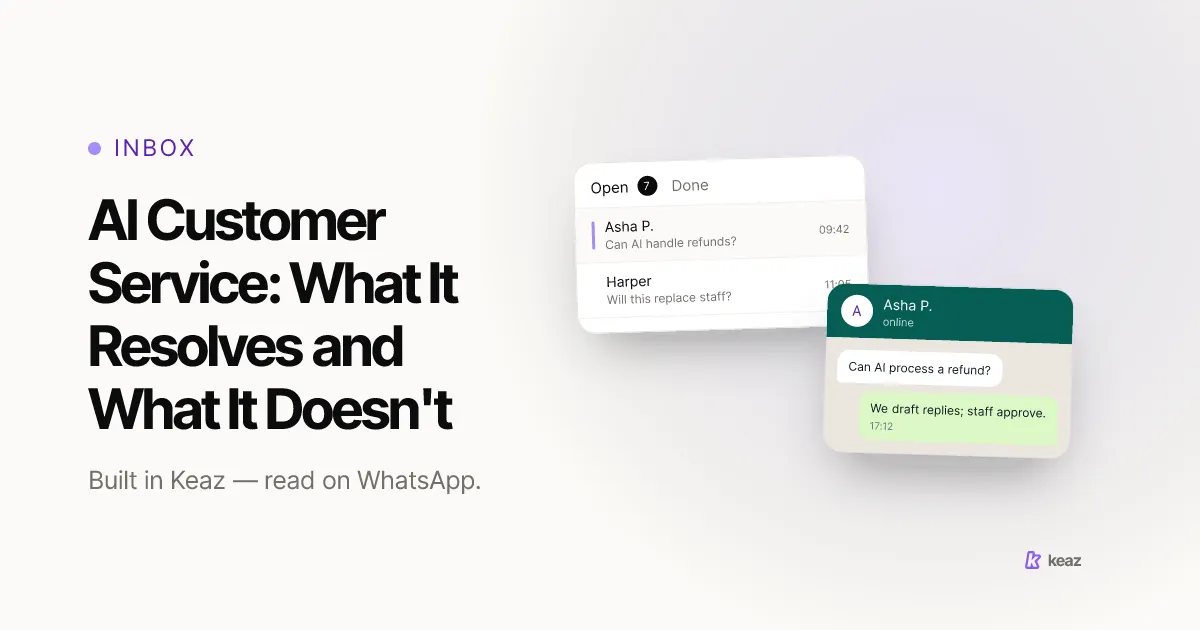
AI customer service works on the questions you already answer the same way every day — where is my order, how do I return this, do you ship to Austria. It does not work on the ones that need a judgement call about your store's money. For a Shopify store running WhatsApp, the honest split is: automate the answers that never change, keep a person on the rest, and count which is which before you buy anything.
- 80% of common customer service issues will be resolved autonomously by agentic AI by 2029, Gartner forecasts — and the word doing the work in that sentence is common (Gartner, 2025).
- $3 per resolution is what Gartner expects generative AI to cost by 2030 — higher than many offshore human agents (Gartner, 2026).
- 3 rule-based automations — Keywords, Conversation Starter, Default Reply — cover most repeat questions in Keaz with no model in the loop.
What does AI customer service actually resolve?
Strip the marketing away and the term covers three different things sold as one. A deflection layer that answers before a person sees the message. A drafting layer that writes a reply for someone to approve. And an agentic layer that takes an action — issues the refund, changes the address, cancels the subscription.
Only the third is genuinely new, and it is the furthest from reliable. Gartner forecasts that agentic AI will autonomously resolve 80% of common customer service issues without human intervention by 2029 (Gartner, 2025, retrieved 2026-09-28). Common is the load-bearing word. A store shipping 400 orders a month has perhaps eight question types that repeat and a long tail that repeats never.
So start by counting, not by buying. Take one month of inbox threads and sort them by the customer's first message. If your top five question types cover more than half the volume, you have an automation problem, and automation is much cheaper than intelligence.
Which questions should you automate first?
Automate a question when the answer is identical every time and a wrong answer is cheap. That is a narrower set than most vendors imply, and it is exactly where a deterministic rule beats a model.
- Order status. The customer wants a tracking link, not a conversation.
- Returns and exchanges. The policy plus a link to the form.
- Shipping countries and delivery times.
- Opt-out and data requests. Not optional: in Keaz the Widerruf, Stop and Datenschutz keywords ship in every account and cannot be deleted.
- Opening hours and how to reach a person.
In Keaz these run as keyword automations: a contact sends a stored trigger word, the saved reply goes out. Anything matching no keyword falls through to the Default Reply. A keyword always wins, so the two never answer the same message. No model, no hallucination surface, and the reply is the one you wrote. The wider question of what belongs in automation at all is covered in our guide to automating customer service.
Where does AI customer service stop working?
Three places, consistently.
Anything that moves money. A refund, a discount, a goodwill gesture on a damaged order. The model has no view of your margin, and a wrong answer here is not a bad reply — it is a cost.
Anything where being wrong sounds right. Ingredient lists, sizing advice, device compatibility, anything compliance-adjacent. A fluent wrong answer in a skincare store is a returns problem at best.
Anything already escalated. Gartner expects regulatory pressure on the right to reach a human to increase assisted service volume by 30% by 2028 (Gartner, 2026, retrieved 2026-09-28). Customers who want a person will find one; the only variable is whether your setup makes that fast or slow.
The working rule: automate the answer, never the decision. A chatbot that resolves five question types well is worth more than one that attempts forty and generates a second support queue about itself.
How does AI fit WhatsApp's 24-hour window?
WhatsApp is not a channel you can write into whenever you like, and that constrains every automated setup running on it.
A customer service window opens when the customer messages you, and it resets each time they message again. While it is open you can send ordinary non-template messages, and Meta does not charge for those. Once it closes, only an approved template can go out, and templates are charged by category (Meta, WhatsApp Business Platform pricing documentation, retrieved 2026-09-28).
So an automated reply is free if it lands inside the window and impossible outside it. That shapes the design more than any model choice does: the automation has to answer while the customer is still in the conversation, not four hours later when a queue drains. Keaz's Conversation Starter exists for the other case — reopening a chat that has already closed.
The window mechanics, the template categories and the current rates all sit on our WhatsApp facts page, which we keep against Meta's own documentation rather than against memory.
What does it actually cost to run?
Two costs, and stores usually budget for one of them.
The subscription is visible. The cost per resolution is not. Gartner's forecast is that by 2030 cost per resolution for generative AI will exceed $3 — higher than many B2C offshore human agents — driven by data-centre costs, AI vendors shifting from subsidised growth to profitability, and complex cases consuming more tokens (Gartner, 2026, retrieved 2026-09-28). Their analyst's summary is blunter than the headline: full automation will be prohibitively expensive for most organisations.
For a store of our readers' size that is not an argument against automation. It is an argument for automating the cheap deterministic half and not paying per token to answer where is my order.
One clarification, because headlines blur it: Meta's separate pricing policy for AI Providers applies to companies offering general-purpose AI assistants on WhatsApp, not to a merchant using automation in its own support. Meta's documentation states explicitly that it does not change what other businesses are charged, including for non-template messages inside an open window (Meta, WhatsApp Business Platform, retrieved 2026-09-28). If you run a shop, that policy is not about you.
Common mistakes
- Buying the agentic tier before counting the questions. A month of thread exports usually shows the top five types carry the volume. Rules handle those.
- Letting it answer everything. Coverage is not the goal. A narrow automation that is always right beats a broad one that is usually right.
- No visible exit to a human. If the route to a person is hidden, customers do not accept the bot — they repeat themselves at it, and the thread gets longer.
- Measuring deflection instead of resolution. A deflected message that comes back tomorrow was not resolved. Count threads that ended, not messages the bot absorbed.
- Automating replies but not the opt-out. Consent handling is the one path that has to work without a person, every time, in every locale.
- Replacing the channel instead of the effort. WhatsApp complements email; automation complements a person. Neither swap works as a straight substitution.
AI customer service is a sorting problem before it is a technology problem. Sort your inbox into questions with one right answer and questions that need a decision, automate the first group with rules you control, and keep a person on the second. That order holds whatever you eventually buy, and it tells you how much you actually need. The automations and flows in Keaz are built for the first group.
Want the revenue side of the same question before you spend anything? Run the Keaz Forecast on your own store data.
Frequently asked questions
Is AI customer service worth it for a small Shopify store?
Does AI customer service work on WhatsApp?
Will AI replace customer service agents?
What is the difference between a chatbot and AI customer service?
Does Meta charge for AI messages on WhatsApp?
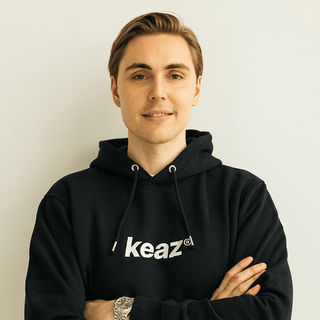
Nils Spölgen
Founder at Keaz. Serial founder in chat marketing — built a local agency into Keaz, the WhatsApp marketing platform for Shopify. Bootstrapped the MVP, raised funding, and scaled to 200+ merchants in DACH. Writes about flows, opt-in & GDPR, Klaviyo, and realistic revenue benchmarks — prefers conservative math over impressive claims. View profile